

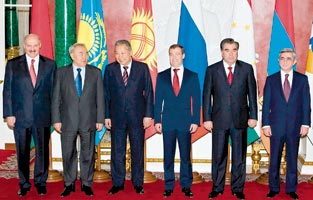
The Kremlin summit decision of the Collective Security Treaty Organization -- made up of Russia, Armenia, Belarus, Kazakhstan, Kyrgyzstan, Uzbekistan and Tajikistan -- came as one of the aid recipients, Kyrgyzstan, announced that the United States must close a key air base on its soil which supports US operations in nearby Afghanistan. This is a fact which strengthens those who label Russia's move as a declaration of a second Warsaw Pact-era.
" As it can be seen with the examples of the Black Sea Economic Cooperation and the Caucasus Stability and Cooperation Platform, Turkey constantly supports and defends all kinds of regional cooperation efforts or platforms aimed at improving the stability and welfare of the region," a senior Turkish diplomat initially noted, when approached by Today's Zaman yesterday for comment on Russia's latest move to reassert influence in the region.
" This is the framework through which Turkey assesses regional platforms, and to do so, we have to know about the mode and content of these platforms. It is too early to say anything about this new move, we're still assessing," the same diplomat, speaking under condition of anonymity, added.
" Besides, questions such as whether this initiative has been launched with good intentions or not and whether it aims to compete with NATO are not questions that should be answered by us, although we are a member of NATO. Whether this move is meant to be a new Warsaw Pact is not a comment which we should be making, as the NATO headquarters will give an answer to this if need be," the diplomat said, while describing Bishkek's decision on the US airbase as a domestic affair for Kyrgyzstan, thus refusing to comment.
Russian President Dmitry Medvedev said the new force, to which Russia would contribute an elite division and a brigade, should be able " to rebuff military aggression," fight international terrorism, drug trafficking and organized crime and handle natural and technological disasters.
" These are going to be quite formidable units," he said. " According to their combat potential, they must be no weaker than similar NATO forces. You must understand the scale [of the plan]. This force will be equipped with the latest in military technology." These powerful phrases in which " a big plan" was hinted at while NATO was also mentioned has connoted the start of a new Cold War for some observers. Meanwhile, Kyrgyzstan's move to shut the US base is said to be a tough challenge for new US President Barack Obama, who plans to send additional troops to Afghanistan.
Multidimensional diplomacy in a multipolar world
" For me, Kyrgyzstan's decision is as noteworthy as Russia's move to create a bloc because this is another concrete act showing us that Russia is returning to the Caucasus in order to establish a military bloc. While doing this, Moscow is also trying to influence certain countries which have distanced themselves from the idea of becoming part of such a bloc. This situation may take us back to the conditions similar to those of the Cold War era, when there was a bipolar world -- centered on Washington and Moscow. This time, we will not see a bipolar, but we will see a multipolar system; but yet again, tensions between Russia and the West will be the determining factor within this multi-polar system," associate Professor Kasım Kamer told Today's Zaman yesterday.
" Turkey took great advantage of the bipolar system. It became a NATO member although it didn't take part in World War II. Now, the new tension will be positively reflected on Turkey's relationship with the West. Of course, Turkey should also outline some new strategies, for example it can improve military cooperation with Azerbaijan," said Kamer, an expert on the Caucasus from the Ankara-based International Strategic Research Organization (ISRO/ USAK).
" The West is facing powerful competition from Russia both in the fields of energy and the military. Turkey's importance will increase through the Black Sea to Central Asia and Ankara will use this to its advantage in this new era," Kamer said.
According to Dr. Mehmet Seyfettin Erol: " This is basically a new or a second Warsaw Pact and another great game has begun. What triggered this new game is Obama's decision to focus on Afghanistan."
With turning its attention to the Collective Security Treaty Organization, Russia wants to assume an integrationist policy in " its Near Abroad," Erol told Today's Zaman, adding that Russia will soon force former Soviet Union countries and Soviet satellite countries in the Balkans, Eastern Europe and the Baltic to join this new bloc.
" Post-Sept. 11 US policies toward these regions handed Russia the opportunity to reach these countries on a plate. Besides, the 'color revolutions' have failed to bring stability to Georgia, Kyrgyzstan and Ukraine. With the war between Georgia and Russia in August, regional countries have understood very well that Russia will not easily cave in to the idea of having US power in this region. In this new 'great game,' Turkey's stance on its policies toward the US, Russia, the Black Sea, the Caucasus, Central Asia, the Caspian, Afghanistan and Pakistan will be very decisive. Since it has become a significant counterbalance in the last six or seven years, it will have a strong, but at the same time delicate position in this great game, which offers both opportunities and risks at the same time," Erol said.
" It will not directly come up against either Russia or the US, but also will continue its multi-dimensional diplomatic moves," he said.
During the brief war between Georgia and Russia over the breakaway region of South Ossetia, Turkey, which neighbors Georgia, kept a low profile and unlike its Western allies, it refrained from condemning Russia's actions. Nonetheless, Turkey's Prime Minister Recep Tayyip Erdoğan swiftly initiated a regional platform of conflict resolution in the volatile Caucasus. The platform, the Caucasus Stability and Cooperation Platform, consists of Armenia, Azerbaijan, Georgia, Russia and Turkey. The platform has already held two technical-level meetings.
" Pakistan, Iran and Central Asia: these are the areas surrounding Afghanistan with which Turkey has good relations. If the US wants success in Afghanistan, it has to have Turkey on side.
In the past, Washington was using political, economical and security-related interventions to keep Turkey on side, but since Turkey has tried hard to overcome its weaknesses related to these issues with its multi-dimensional diplomacy, now the US will have to take Turkey's interests and concerns into consideration if it wants Turkey to help. Russia meanwhile doesn't want to intimidate Turkey as bilateral relations has been based on cooperation but not on competition since the signing of the Eurasia Agreement in New York in 2001. Thus, the step which will be taken by Turkey will be decisive in this big game and with this step; Ankara will not openly side with any of the parties, trying to balance the situation with collective regional efforts," Erol said.EMINE KART ANKARA


