

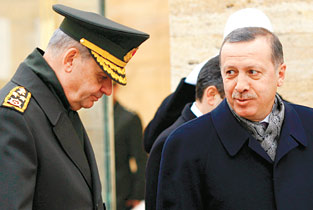
This indicates that a good working relationship is being established between the TSK and the political authority on the Kurdish issue in general, an Ankara-based Western military analyst asserted.
" There have been no objections to the ongoing dialogue between Turkey and Iraq coming from the TSK under Gen. Başbuğ's leadership. This shows not only that the new military leadership is less reactive on the Kurdish issue, but also signals a good working relationship being established between the military and the political leadership -- on the Kurdish issue in particular and on dialogue with Iraq in general," the same analyst said.
The TSK under Gen. Yaşar Büyükanıt, who retired as chief of general staff in August, had openly raised objections even against dialogue with the Iraqi central authority while preventing Iraqi President Jalal Talabani's visit to Ankara.
Talabani, a Kurd, later visited Turkey nonetheless. Brig. Gen. Metin Gürak, director of the communications department of the Turkish General Staff, said yesterday during his weekly press conference that Iraq's contribution to the fight against the outlawed Kurdistan Workers' Party (PKK) is something that the TSK has also been hoping for.
Gürak's remarks have been seen as a concrete sign that the TSK will, at least, continue its policy of not creating any obstacles for the Turkish political leadership in its recently improved relationship and progress with Iraq and the Iraqi Kurds.
" We have also been following the developments," Gürak said in response to a question on Iraqi Prime Minister Nouri al-Maliki's one-day visit to Ankara on Wednesday.
Maliki's visit came shortly after remarks made by Talabani to CNN Türk early this week suggesting a general amnesty for members of the PKK to bring them down from the mountains. However, Talabani suggested that senior PKK members not be put in jail once they surrender.
Gen. Başbuğ announced soon after assuming the post of chief of general staff in September that he was in favor of bringing the young terrorists down from mountains. But he ruled out a general amnesty, which would mean more than 150 PKK leaders.
Neither the government nor the Turkish public is ready for any attempts to pardon the senior PKK leadership.
On the contrary, as the municipal elections -- scheduled for March 29 -- draw closer, the ruling Justice and Development Party (AK Party) has continued to adopt a more hard-line rhetoric on the Kurdish issue, even if it helps increase the strength of the PKK.
The AK Party fears losing its seats not just nationwide, but also in the predominantly Kurdish Southeast at a time when nationalistic fervor has risen in the country, making it difficult to pursue a softer stance on resolution of the Kurdish problem. The party won 41.9 percent of the nationwide vote during the 2004 local elections, the Supreme Election Board (YSK) recently noted.
However, despite the Turkish state's cautious approach to its own Kurdish problem, the ongoing debate in Turkey over Kurdish rights helps the government in readying the Turkish public, which fears the country will risk division if Kurds are granted more rights, to address Kurdish grievances.
A newly published report by the İstanbul-based Turkish Economic and Social Studies Foundation (TESEV) on the Kurdish question and the beginning of test broadcasting for a 24-hour television station for Kurdish-language programming, in addition to Arabic and Farsi content, by the state-controlled Turkish Radio and Television Corporation (TRT), have stirred debate on the issue.
Progress yields results in economic arena
Over the past year Turkey and Iraq have made significant progress in establishing dialogue. President Abdullah Gül is expected to visit Iraq as early as next month.
For the first time since the US invasion of Iraq in March 2003, Iraqi Kurds have also been included in a three-way dialogue mechanism launched two months ago between Turkey, Iraq and the US to address the PKK problem.
A Western military analyst speaking to Today's Zaman described the dialogue as significant progress between Turkey and Iraq compared to last year.
Turkish-Iraqi dialogue will also benefit Turkey in securing permission from the Iraqi government for future aerial operations staged in northern Iraq against PKK hideouts, the same analyst said.
Under the recently signed US-Iraq Status of Forces Agreement (SOFA), it is understood that the US should transfer real-time intelligence data for pinpointing PKK targets in northern Iraq that it had been relaying to Turkey directly to Iraq as of next month.
Then it would be up to the Iraqi government to relay the intelligence information to Turkey, according to Safeen Dizayee, foreign affairs director of the Kurdistan Democratic Party (KDP), in a recent interview with Today's Zaman.
Meanwhile, as a reflection of the benefits of the Turkish-Iraqi dialogue mechanism, Turkish Minister of Energy Hilmi Güler will soon visit Iraq to sign a deal on natural gas transportation.
" The Iraqis view the idea of transporting Iraqi natural gas through Turkey positively. Our energy minister will go to Baghdad to negotiate the issue and sign a deal," Prime Minister Recep Tayyip Erdoğan told reporters on Thursday.


