

Looking at the example of Italy's Operation Gladio, the existence of such an organization in Turkey is not unlikely. Legendary Italian prosecutor Felice Casson, who discovered the existence of Operation Gladio, a NATO stay-behind paramilitary force left over from the Cold War, said in Turkey last year that Gladio's first attack in Italy was considered a "small-scale crime committed by local people."
Nevertheless, he pursued the case and he was supported by the Italian prime minister at the time. Casson noted that the reason for this support was the toppling of the Berlin Wall, which rendered Gladio obsolete for Italy. Now there are arguments that the unipolar international system created by the US at the end of the Cold War may be rendering Gladio obsolete for Turkey. Many analysts believe such networks in Turkey could be remnants of the Turkish leg of Gladio.
|

In addition, Casson noted that Gladio, which made use of small, isolated cells that did not coordinate their activities, survived for 40 years. Looking back at when discoveries related to "Ergenekon" first surfaced, it was former Prime Minister Bülent Ecevit who was the first to learn of the existence of this secret formation.
In a 1977 speech he had said "an organization inside the state, but outside the state's control" had carried out the incidents of May 1, 1977, when unknown perpetrators opened fire on a crowd gathered in Taksim Square for May Day celebrations, resulting in the deaths of 36 people. Ecevit narrowly escaped an assassination attempt just 20 days after making this statement.
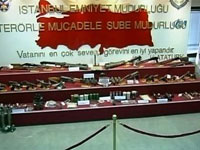
The Ergenekon investigation started in July 2007 when a house full of weapons and munitions was found in the Ümraniye district of İstanbul. Grenades found in the house matched the batch numbers of those used in two attacks on the Cumhuriyet newspaper in May 2006, carried out by the same gang responsible for the April 2006 attack on the Council of State in which a judge was killed. The police investigation resulted in the discovery of a shadowy gang with links to state agencies, and possibly the military, that had attempted to create an atmosphere conducive to a military takeover against a number of governments, most recently the Justice and Development Party (AK Party).
Academics, businessmen, mafia bosses and retired military officers, including former generals, are among more than 100 suspects accused of various crimes in the indictment against Ergenekon, submitted to a court in the middle of last summer. In 1984 Casson discovered that explosives used in an attack that killed three gendarmes in Pateano in 1972 came from an arms depot belonging to a secret organization. As the investigation into the attack developed, the existence of an organization named Gladio was discovered. Eventually the investigation revealed more than 600 Gladio members, including two people who had served as prime minister and president.
In the course of his six-year investigation, Casson was harassed and threatened even by the members of the government; however, he went ahead and searched the documents of the military intelligence services in the process. As a result, he revealed Gladio's 4,300 operations between 1969 and 1980. Casson also revealed the influential role of President Francesco Cossiga and Prime Minister Giulio Andreotti, who was sentenced to 20 years in prison but had his sentence overturned by the Italian Supreme Court. Thirty generals, four state ministers, 19 top judges and 58 professors were arrested at the time.
Another similarity between the Gladio and Ergenekon investigations relates to the discovery of secret ammunition depots. Casson's investigation revealed 130 of them in Italy. In Turkey police have been searching for more hidden weapons following the discovery of weapons, ammunition and bombs buried in Ankara last week. In 2000 a report presented to the Italian Senate indicated that Gladio had waged a war "against internal enemies" and that operations had been carried out by people who were in contact with US intelligence services. Many analysts in Turkey have indicated that the founders of Ergenekon probably had a common motivation -- "to save the country."
Turkey has yet to clean up its own Gladio. That is also what Casson stressed when he said: "You must go to the end in the investigation. There are such significant accusations that you have to go to the end to clarify things. Otherwise, this is very dangerous for democracy."EMRE SONCAN İSTANBUL


