Optimism and hope have increased for an eventual solution to the terror problem following growing support from political parties and civil society groups for ongoing talks between state officials and terrorist Kurdistan Workers' Party (PKK) leader Abdullah Öcalan to broker a deal for the disarming of the terrorist group, even though the prime minister announced that house arrest for Öcalan and general amnesty for terrorists are out of the question.
The talks with Öcalan are carried out by National Intelligence Organization (MİT) head Hakan Fidan, whose position as a negotiator on behalf of the Turkish state was confirmed earlier by the government.
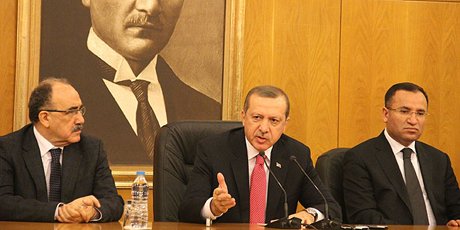
Prime Minister Recep Tayyip Erdoğan called a press conference on Sunday and said the talks with the PKK leader are not new. “Our struggle is to be successful in the fight against terror,” he said, adding that politicians from his Justice and Development Party (AK Party) have not taken a part or will not do so in talks with Öcalan.
Erdoğan also said the success of the talks depends on support to come from the people. “We will be successful if we join our hands. We have not managed this so far. We have not received the support of the print media or the civil society yet,” he complained, adding that a house arrest is out of the question for Öcalan, a demand voiced for a long time by supporters of the terrorist PKK, as well as a general amnesty for PKK terrorist who participated in bloody attacks against security forces or civilians.
The PKK, listed as a terrorist organization by Turkey and much of the international community, has waged a bloody campaign for self-rule in predominantly Kurdish-populated southeastern Anatolia since 1984. More than 40,000 people, including civilians and security forces, have been killed in clashes with the terrorist group.
Öcalan, imprisoned on İmralı Island in the Marmara Sea south of İstanbul since his capture in 1999, has significant influence among PKK members and supporters. The Turkish state believes talks with the terrorist head may lead to a timetable for withdrawal of PKK terrorists from Turkey and eventual disarmament.
Foreign Minister Ahmet Davutoğlu also spoke to reporters on Sunday and said the talks with the leader of the PKK is not something new. “We have preferred this method [negotiation or talks] from the very beginning, but turned to military operations when the terrorist group attacked us [Turkey]. Work in the recent weeks is being carried out in complete coordination, and everybody does what they can. … What is important for the time being is the continuation of the process. Dialogue will carry on with everybody who has influence on the [terror] issue,” he stated.
On Saturday, the main opposition Republican People's Party (CHP) convened its party council to discuss the talks. At the end of the approximately seven-hour meeting, the party decided to lend its full support to the talks. “We will not block the talks. On the contrary, we will support them. We want the [negotiation] process to yield positive results. And our criticism will be aimed at improving the process. We are not biased, but we want to be informed about the course of the process,” stated Kemal Kılıçdaroğlu, chairman of the party, at the end of the meeting.
News sources said CHP's Kılıçdaroğlu ordered his party members to avoid any statement or behavior that may lead to the perception that the CHP is divided over support to government talks with the PKK leader. “We issue a new credit [meaning chance] to the [AK Party] government. There are four issues they must pay attention to. First of all, they have to be sincere and honest. Second, they should not seek a personal agenda [for the talks]. Third, they will not engage in any agreement or plan they cannot explain to the people, and last but not least, they will provide information to the main opposition party or the people about the course of the talks,” Kılıçdaroğlu told reporters.
Also on Saturday, Deputy Prime Minister Bekir Bozdağ said the AK Party has risked itself for the sake of solving the terror problem. “If it [the terror problem] is not concluded, the ones who put their bodies under the stone will pay for the price. And those are the political power [AK Party] that will pay that price. Everyone will benefit if the process is concluded successfully,” he stated.
This is the third time Turkey has held talks with the PKK. The last time was in Oslo when Fidan headed a MİT delegation in 2010. The talks were ineffective and were interrupted in July 2011 when the PKK staged a fatal attack in Silvan, Diyarbakır. Talks were re-launched two months ago, although this was revealed to the public only recently when the government decided that the jailed PKK leader still has power over the organization's supporters, as a call from him made to Kurdish prisoners who were on a collective hunger strike was enough to end the protest. However, some experts have expressed doubt that PKK commanders fighting in the mountains will obey when it comes to laying down their weapons.
Optimism was widespread in many Turkish newspapers on Sunday about the solution of the terror problem through talks with the terrorist head. Many newspapers said Turkey has obtained a chance to solve the problem thanks to the government's “courage to hold talks with Öcalan.”
Claims emerged on Sunday that Aydın Doğan, owner of Turkey's largest media group Doğan Publications Holding (DYH), sent letters to his TV channels and newspapers, urging their administrations to lend their support to the ongoing talks to eliminate the terrorist group. “Maintain a peaceful language and avoid any behavior or comment to disrupt the [negotiation] process. Be extremely careful when writing news reports or columns about the process,” Aydın stated in his letter.
The pro-Kurdish Peace and Democracy Party (BDP) has remained silent about the talks. Two officials from the party met with Öcalan last week, but refused to make a statement to the press. The party's co-chairs are expected to call a press conference to detail what the BDP's position is as regards the current negotiations.
Fidan: DDR main objective of talks
In the meantime, some Turkish newspapers have begun speculating about a roadmap adopted by the state during the talks with Öcalan.
The Sabah daily quoted MİT's Fidan as saying that the roadmap has three legs: demobilization, disarmament and reintegration (DDR). As part of the roadmap, the PKK will initially be urged to stop its bloody campaign inside Turkey, then lay down its weapons, and eventually its members will be rehabilitated and reintegrated into the society.
Fidan reportedly said the Turkish state also has plans to hold contacts with PKK leaders on the Kandil mountains and in Europe besides Öcalan. However, he said, there is not mutual trust for the talks. “Talks [with Öcalan] will show us if there is divergence of opinion [between PKK commanders in Kandil and Europe] for the disarmament of the terrorist group,” Sabah quoted the MİT head as saying.
According to Fidan, Öcalan is the key interlocutor in talks, but he is not the only person with whom the Turkish state plans to negotiate for the solution of the terror problem. Turkey plans to urge the PKK to lay down arms by 2014.
The Yeni Şafak daily, on the other hand, claimed that the MİT has set up a nine-member team to carry out the talks with Öcalan and other leaders of the terrorist PKK. The talks with the PKK higher-ups will be conducted either in Arbil or somewhere in Europe, and Kandil assigned PKK commander Sabri Ok to carry out the talks on its behalf.
Optimism prevails for İmralı talks despite PM's vow against house arrest
Optimism and hope have increased for an eventual solution to the terror problem following growing support from political parties and civil society groups for ongoing talks between state officials and terrorist Kurdistan Workers' Party (PKK) leader Abdullah Öcalan to broker a deal for the disarming of the terrorist group, even though the prime minister announced that house arrest for Öcalan and general amnesty for terrorists are out of the question.