

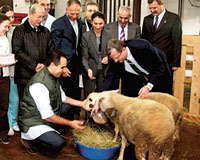
The project that oversaw Oyalı's birth was sponsored by the State Planning Organization (DPT) and the Scientific and Technological Research Council of Turkey (TÜBİTAK). In the project, 69 cloned embryos were transferred to eight sheep. The results were Oyalı, born Nov. 21, 2007, and Zarife, born seven days later, from two different sheep. Birler spoke in glowing terms about Oyalı's health and general development yesterday, noting: " Our cloned sheep is only 1 year old, and actually, the animal from which we created this clone was much younger than the one Dolly was cloned from. Dolly was cloned from a 6-year-old sheep, while ours was under 1 year old. I believe Oyalı will live just as long as a normal sheep would."
A $50,000 house pet
Birler noted that her team had received a few requests to clone house pets. " Abroad, cloning animals on request be done for $50,000," she said. " If we decide we are going to offer such a service, that's when we'll decide on the cost." Speaking about how she has worked on the subject of animal reproduction for 25 years, Birler noted: " Cloning is just one of these ongoing projects. Cloning is a step, and when we complete this step, the other projects will fall into place. When Oyalı was first born we expressed this -- that this is not the end, but just the beginning."
Birler said her team at the university was working on the transgenetic production of lambs. " Our real goal is to produce proteins from sheep's milk that can be used to benefit the health of humans and animals. We are continuing our work in search of special elements and medicines that could be helpful for human health."
The world's first ever recorded cloned mammal, Dolly the sheep, was born on June 5, 1996. She was cloned from the chest cells of another sheep at the Roslin Institute in the Scottish capital of Edinburgh. Dolly died of lung failure at the age of 6.


