

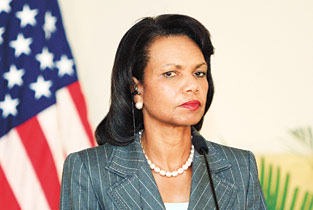
US Secretary of State Condoleezza Rice urged Pakistan to give its "absolute, total" cooperation in finding those responsible for last week's attacks.
The fallout prompted a second top politician from the ruling Congress Party to resign, amid growing fury at intelligence lapses many Indians believe let 10 gunmen kill 183 people and besiege India's financial capital for three days.
The attacks, which struck Mumbai's two best-known luxury hotels and other landmarks in the city of 18 million, are a major setback for improving ties between India and Pakistan.
India fired the first formal diplomatic salvo on Monday after days of fingerpointing, releasing a statement from the foreign ministry describing the actions it expects Islamabad to take.
"It was conveyed to the Pakistan high commissioner that Pakistan's actions needed to match the sentiments expressed by its leadership that it wishes to have a qualitatively new relationship with India," the statement said.
"He was informed that the recent terrorist attack on Mumbai was carried out by elements from Pakistan. Government expects that strong action would be taken against those elements, whosoever they may be, responsible for this outrage," it said. The White House said Rice would visit India on Wednesday, underscoring the seriousness with which Washington viewed the attacks.
"I don't want to jump to any conclusions myself on this, but I do think that this is a time for complete, absolute, total transparency and cooperation and that is what we expect (from Pakistan)," Rice told reporters traveling with her to London.
She played down the threat of conflict between two countries, which almost came to war in 2002 after an earlier attack on India's parliament which also was blamed on Pakistani militants.
"This is a different relationship than it was a number of years ago. Obviously they share a common enemy because extremists in any form are a threat to the Pakistanis as well as the Indians," Rice said.
A team from the US Federal Bureau of Investigation was in Mumbai on Monday to help with the probe into the attacks, in which six Americans died, an embassy spokesman said.
Two senior Indian investigators told Reuters on condition of anonymity that evidence from the interrogation of Azam Amir Kasav, the only gunmen of the 10 not killed by commandos, clearly showed that Pakistani militants had a hand in the attack. The clean-shaven, 21-year-old with fluent English was photographed during the attack wearing a black T-shirt emblazoned with the Versace logo. He has said his team took orders from "their command in Pakistan", police officials said.
The training was organized by the Lashkar-e-Taiba militant group, and conducted by a former member of the Pakistani army, a police officer close to the interrogation told Reuters on condition of anonymity because he was not authorized to speak.
"They underwent training in several phases, which included training in handling weapons, bomb making, survival strategies, survival in a marine environment and even dietary habits," another senior officer told Reuters.
The Pakistani-based Lashkar-e-Taiba made its name fighting Indian rule in Kashmir but was also blamed for an attack on the Indian parliament in 2001 that brought the nuclear-armed neighbors close to war the next year.
Lashkar had close links to Pakistan's military spy agency in the past, security experts say, although the government in Islamabad insists it too is fighting the group and other militants based on its soil.
'No one acted'
India said on Sunday it was raising security to a "war level" and had no doubt of a Pakistani link. The interior minister, who was appointed to the post after the attacks, told reporters on Monday New Delhi would respond "with determination and resolve" to the threats facing the nation.
"This is a threat to the very idea of India, very soul of India," Palaniappan Chidambaram said. New Delhi has not accused Islamabad's civilian government of involvement, but it has expressed deep frustration that its neighbor has been unable or unwilling to prevent militants using its soil to attack Indian cities.
Pakistan denied Indian TV reports on Monday that its envoy to India had been summoned over the crisis, an embassy official in New Delhi said, adding that a planned meeting with Indian authorities was scheduled and routine.
Pakistan President Asif Ali Zardari has appealed to India not to punish his country for last week's attacks, saying militants could precipitate a war, the Financial Times reported on Monday.
"Even if the militants are linked to Lashkar-e-Taiba, who do you think we are fighting?" Zardari told the newspaper.


