


The speech Peres gave involved a strong call for peace, despite the fact that the very same speech could have been criticized on a number of points.
Stressing that millions of Israelis were unable to sleep in peace and comfort, Peres made reference to a growing problem for his people. Obviously, lack of safety and security is a huge problem for even one person. It is a problem that needs to be addressed adequately and in a timely manner. Yet it is possible to resolve this issue by relying on reason and human intellect because there is nothing a rational man cannot solve.
A thorough review of the problems, presented as irresolvable, reveals another dimension of the human mind -- the tendency to rely on the easy way out -- while also pointing to an attempt to look like a defender and promoter of peace.
Seeking justice and peace is a difficult task. It requires one to confront the responses by those who exploit the situation of apparent insolubility and the strong reaction by the masses, which have been deceived by lies and distortions; however, it is easy to perceive the prolonging of the state of insolubility as an attempt to maintain stability and peace. Indeed, manipulating the masses by relying on the "irresolvable strategy" would make one's job easier. This strategy is the number one cause of the major problems in our world today. Devising plans and policies that will exacerbate the problems and draw the approval of the masses is a major crime. The human mind notices this trap only in the democratic process. It can develop a method to eliminate this state of "irresolvability" only if it effectively deals with the lack of knowledge at the root of the problem.
The human mind is the only authority that can resolve the problems of the Israeli people. The conscience was created just in case there is a delay in the resolution of problems by the mind. Believers of celestial religions are called upon to rely on the mind and reason and to avoid extremism. War is a last resort in the event that the problems are not resolved via reason and if conscience is unable to address the problem.
We should recall that wars are conducted according to certain rules and laws. The basic rule that needs to be observed in wartime is the inviolability of civilian lives. It is obvious that violence will breed more violence. Spilling the blood of civilians and noncombatants is terrorism.
Regardless of whether it is an organization or state, any entity that does not discriminate between combatants and civilians is committing terror crimes.
How many innocent lives must be lost in order to understand that relying on acts of terror is not a viable option to eliminate terrorism?
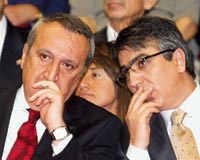
 Former DP Chairman Mehmet Ağar (L) and former Motherland Party Chairman Erkan Mumcu asked their deputies not to attend the plenary session in Parliament for presidential elections in April 2007. Voice recordings reignite debates over presidential elections The voice recordings of a phone call made by former Chief of General Staff Gen. Ismail Hakkı Karadayı have restarted a debate over the presidential elections and subsequent developments in April 2007. The recordings, which were posted on the Internet, reveal that Gen. Karadayı told former Motherland Party (ANAVATAN) Chairman Erkan Mumcu not to attend the plenary session in Parliament. Karadayı confirmed making the call but argued that he had not made any insulting remarks to Mumcu. Mumcu, who has denied the allegations that military officers called to ask him not to attend the plenary session, argued that his party boycotted the parliamentary discussions to ensure that the president would be elected by popular vote. Interestingly, Mumcu supported the constitutional amendment on the presidential elections despite a warning by Karadayı, as heard in the voice recording. Figures close to Mumcu and Democrat Party (DP) Chairman Mehmet Ağar noted that both leaders made the notorious decision at the last minute, implying that they made up their minds not to attend the vote under great pressure. Former DYP deputy Ümmet Kandoğan, who attended the vote despite the party's decision, said: "The voice recording confirms what happened that day. Despite my insistence, both party leaders failed to attend the session. The allegation indicating that YÖK [Higher Education Board] Chairman [Erdoğan] Teziç would be assassinated was a provocation to influence their decision. It has become apparent now that both leaders were threatened with a military coup. The e-memo on April 27 has already confirmed the threat." Mumcu argued that he was removed from the political stage by these developments, whereas DP leader Süleymen Soylu, who succeeded Ağar, called on both leaders to give a plausible explanation to the people. A senior politician noted: "Boycotting the parliamentary session was actually pretty good because it enabled purification in politics; however, it is also upsetting to realize that the threat of a military coup intimidated political party leaders." |
Israel contributed to emergence of situation it did not desire
A senior politician who was fairly close to former President Turgut Özal has stated that Israel contributed to the emergence of a situation that it was actually afraid of, referring to the tension between Prime Minister Recep Tayyip Erdoğan and Israeli President Shimon Peres in Davos.
"Israel's biggest fear was unification of the Arab world; it was also afraid of Turkey's attempts to remove the disparities between the Arab countries by pioneering the peace talks. Turkey now serves as the facilitator of this process," he noted. The same comment further implies that Israeli Prime Minister Ehud Olmert's visit to Turkey just four days before the start of the attacks on Gaza and his failure to inform Erdoğan about the attacks were actions meant to help reach the goal of preventing the Arab world from unifying. Israel was trying to undermine Turkey's role as a mediator that would achieve peace while it wanted to appear as if it was supporting Turkey's efforts. Israel was relying on this option because Turkey's growing role in the Middle East might have served to remove the differences in the Arab world; however, Israel has made an effort to foment clashing views among Arab and Islamic countries.
The honorable stance of Erdoğan, destroying the taboo implying that Israel may not be criticized in Davos, won the hearts of millions in the Islamic world. The growing interest and appreciation of the masses toward Turkey and Erdoğan may lead to important developments. ALI ASLAN KILIÇ ANKARA


