

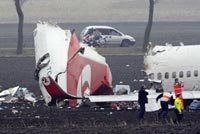
Five Turks and four Americans were killed when the Boeing 737-800 plunged into a muddy field short of the runway at Schiphol Airport on Wednesday. Among the dead were three pilots and a flight attendant.
Investigators are looking into the scene in an attempt to discover the cause of the crash and say the accident may have been caused by any of a wide range of factors, from weather-related causes to insufficient fuel, navigational error, pilot fatigue or birds.
Turkish Pilots Association (TALPA) Vice Chairman Savaş Şen told a news conference on Friday that a Boeing heavy aircraft appeared to have landed on the same runway just two minutes before the THY plane. Şen said wake turbulence, a sort of air turbulence caused by a pair of vortices trailing in the wake of an aircraft's wing tips, could have hit the descending Turkish plane, disrupting its flight. He blamed the Schiphol control tower for failing to issue full information to the THY plane about the heavy plane landing on the runway. A Dutch Safety Board spokesman said wake turbulence was one of the options its investigators were looking at.
" We look at all options, and we certainly are not excluding this one," spokesman Fred Sanders said. The board is expected to present a preliminary conclusion of its investigation this week.
TALPA officials ruled out the possibility of engine failure or pilot error as the reason behind the crash. " There should be a distance of at least five miles between two planes. However, the preliminary investigation has revealed that the distance between the THY plane and the heavy aircraft in front of it was four miles. Did the Schiphol control tower warn our plane about the possibility of wake turbulence? We want these points to be cleared up," Şen said. TODAY'S ZAMAN WITH WIRES İSTANBUL


