

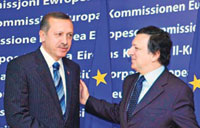
Erdoğan arrived in Brussels on Sunday evening, marking his first visit to the EU capital since a December 2004 EU summit when EU leaders agreed that Turkey had sufficiently fulfilled the Copenhagen criteria related to democracy and the rule of law and was able to open negotiations for full membership.
" Accession to the EU is a top priority for Turkey. I hope there will be a leap in 2009," Erdoğan told a conference at the European Policy Centre ahead of his meetings with European Commission President José Manuel Barroso, EU foreign policy chief Javier Solana and EU Enlargement Commissioner Olli Rehn.
Erdoğan's trip comes as Ankara faces pressure from the EU to speed up reforms in a decisive year and amid questions over its commitment. EU officials have said privately that Turkey, which began accession talks in 2005, may face a deadlock if progress is not made this year while analysts warn that trust is ebbing and that the two sides must rebuild momentum.
Underlining the Turkish government's commitment to making further reforms, the prime minister complained about the lack of cooperation by opposition parties that " have been trying to delay and hinder" legislative work in Parliament.
Analysts have said the ruling Justice and Development Party (AK Party) has put the EU agenda on the backburner because of political distractions at home and a lack of eagerness to enlarge the EU among member states after the bloc's costly expansion into Central and Eastern Europe. Powerful states such as Germany and France are not keen on expanding and question the European credentials of the overwhelmingly Muslim country of 70 million people. Turkey is not expected to become a member of the EU for at least another decade.
|

Erdoğan said Turkey was working on many of the reforms requested by the EU, including laws governing trade unions. Listing legislative amendments carried out by the government in relation to the EU process, Erdoğan highlighted the government's launch of a 24-hour Kurdish-language TV channel on the state-owned Turkish Radio and Television Corporation (TRT).
The Kurdish channel, named TRT 6, " has the characteristic of a roadmap for new reforms that will be made in the next four years," Erdoğan said.
He also reiterated a certain criticism toward the 27-nation bloc, saying that the EU is going too slowly with the accession process, opening only two chapters every six months.
Turkey has opened talks on 10 out of the 35 so-called negotiation chapters, of which it has provisionally completed negotiations on just one. The bloc has frozen eight chapters in Turkey's accession talks because of Ankara's refusal to open its ports and airports to Greek Cyprus. France, which opposes Turkish membership, refuses to open talks on five chapters that it says are directly related to accession.
" Opening two chapters during every term presidency has become almost a routine," Erdoğan said, noting that nothing seems to be changing with the Czech Republic's ongoing term presidency, though former term president France's President Nicolas Sarkozy pledged to review the situation.
Ankara says the EU still hasn't approved end-of-screening reports on nine negotiating chapters despite the fact that Turkey's screening process was completed in 2006. The government also says Turkey will know what kind of technical preparations it should make on these nine chapters once the EU approves the end-of-screening reports.
" We don't ask for privileges; what we ask for is equal and fair treatment," he said, complaining that parts of the negotiation process had been blocked for political reasons and emphasizing that Ankara didn't consider an alternative to the EU for its future.
Greek Cyprus and Nabucco
The Greek Cypriot administration's EU entry in 2004 in the absence of a comprehensive resolution to the Cyprus issue was " inappropriate," Erdoğan said. " Shouldn't we recognize this reality? Should we swallow it?" he asked. " It is not swallow-able at all."
Turkey, which does not recognize the Greek Cypriot administration, has called on the EU to fulfill its commitment to take steps to end the isolation of the Turkish Cypriots as a condition to opening its ports and airports to traffic from Greek Cyprus. The EU unveiled a plan to ease the isolation of the Turkish Cypriots after they voted for a UN plan to reunite the island, but it was never implemented because of opposition from other members and Greek Cyprus, which joined the EU a few days after the Greek Cypriots rejected the same UN plan in April 2004 in a simultaneous referendum.
Greek Cyprus, accused by Ankara of using its veto rights over Turkey's EU accession process, said last month it would not let talks on the energy part of the accession process start until an oil exploration dispute was resolved. Greek Cyprus has accused Turkey of harassing hydrocarbon research vessels four times since Nov. 13.
Erdoğan said yesterday that Turkey would review its support for the Nabucco gas pipeline to Europe if the energy portion of its EU accession talks remained blocked. He also raised doubts about the $12 billion project, seen as one of Europe's best hopes for limiting its dependence on Russian gas.
The EU has sought to diversify its energy sources since Russia's invasion of Georgia last summer and the gas dispute between Moscow and Kiev, which has curtailed supplies across Ukraine to Europe.
The EU is backing the Nabucco pipeline, which is one day hoped to carry 30 billion cubic meters of Caspian or Middle Eastern gas annually to an Austrian hub via Turkey.
" If we are faced with a situation where the energy chapter is blocked, we would of course review our position," Erdoğan said, while questioning whether there was enough gas available to justify Nabucco, which enters Europe via Turkey.
" The information is that the countries that say that they will provide sufficient amounts of natural gas do not have enough natural gas to provide," he said. " In the Nabucco project, there needs to 30 billion cubic meters of natural gas flowing, but it's not there."
Analysts say only 3 billion cubic meters has been sourced for the pipeline, compared to a minimum of 15 billion cubic meters needed to get it started.
Iran remains a potential source of gas for Nabucco, and Erdoğan criticized countries that oppose taking Iranian gas for political reasons.


