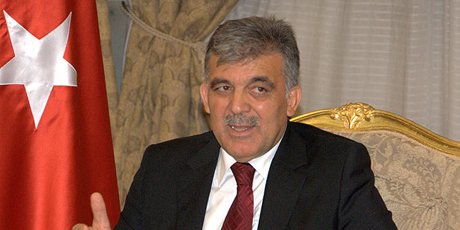
Turkish President Abdullah Gül has identified the country's bid to join the European Union as the root cause of its success over the past decade, and has urged Ankara to intensify its efforts to accede -- in a sharp contrast to the approach of the country's prime minister.
The move highlights the increasingly divergent views of Turkey's two top executives. In an interview with the Financial Times (FT) published Tuesday, Gül emphasized that Turkey has to agree on a new constitution by consensus. Meanwhile, Prime Minister Recep Tayyip Erdoğan has made the establishment of an executive presidency the focus of his push for a new constitution.
Erdoğan has also recently suggested that Turkey should reinstate the death penalty, a move that would effectively put an end to the country's EU ambitions.
But President Gül told the FT that despite difficulties with the negotiations in Brussels, the country's efforts to join the EU were the root cause of the political stability and economic growth it has enjoyed over the past decade.
“If you look at the totality of these reforms that have been enacted in the last 10 years, they are an adaptation of the EU acquis [the bloc's accumulated legislation],” he told the FT. “We should not stop here; it's not sufficient ... We have to strongly carry forward the reforms.”
Turkey's political life is dominated by the two men, but Erdoğan is now seeking to make changes to the Constitution to enhance the powers of the presidency ahead of a widely expected bid of his own for the position.
“His discourse is different from mine,” Gül told the FT, emphasizing that he and Erdoğan had together built up the Islamist-rooted Justice and Development Party (AK Party), which has ruled Turkey for a decade. “I as president am not a politician ... I represent or look at the picture from a broader perspective and I embrace everyone... [but] I wouldn't say something if I didn't believe it,” Gül said.
Too early to speak of premiership, Gül says
In remarks that further highlight his contrasts with the prime minister, who is highly combative towards political opponents, the president said Turkey needed a strong opposition if democratic checks and balances were to function, and did not rule out becoming prime minister himself at a later date. Asked about the premiership, he said: “It's too early [to speak of]; I have still two years in this job.”
Erdoğan, who is by far the most powerful figure in Turkey as the current prime minister, has promised to leave the post by 2015 because of party term limits
There is a near-universal belief among the public that Erdoğan hopes in the 2014 election to become Turkey's first president under a new presidential system, as he can't run for prime minister again due to the AK Party's self-dictated rules, which don't allow deputies to run for office more than three consecutive times.
Although Gül, by contrast, has a largely ceremonial role, he has asserted his authority at times. In the interview, he suggested a greater focus on realpolitik to deal with the war in Syria.
“The most important actor here is Russia,” he said, referring to Moscow's seat on the UN Security Council and its naval base in Syria. “What is required to engage the Russians is to find some face-saving [initiative] that would allow them to change their current position,” Gül told the FT.
Russian President Vladimir Putin is due to visit Ankara next month.
President Gül calls on Turkey to intensify efforts to join EU
Turkish President Abdullah Gül has identified the country's bid to join the European Union as the root cause of its success over the past decade, and has urged Ankara to intensify its efforts to accede -- in a sharp contrast to the approach of the country's prime minister.