

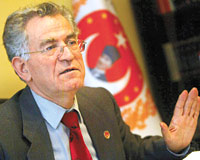
The revelation renewed suspicions about Karadağ, whose name has surfaced several times in connection with the "deep state."
Jailed outlawed Kurdistan Workers' Party (PKK) leader Abdullah Öcalan claimed earlier this month that the killings of 33 soldiers in Bingöl were the work of a former PKK leader who had received orders from a clandestine criminal network suspected of plotting to overthrow the government.
There is further speculation that the soldiers were killed to prevent a solution of Turkey's terrorism problem at a time when the government was involved in negotiations with Öcalan and preparing a general amnesty for PKK members.
Erdal Özdemir, a survivor of the Bingöl attack, said that just before the attack, he was on duty in Malatya when his unit was unexpectedly ordered to travel to Bingöl without any escort or security measures, as quoted by the Bugün daily yesterday. He said they were defenseless and that soldiers who objected to traveling at night were threatened with beatings.
Another area where Karadağ's name has been mentioned in relation to Ergenekon is the 2001 murder of prominent Turkish businessman Üzeyir Garih. According to a report by the Yeni Şafak daily, Yener Yermez, who stabbed Garih to death in a cemetery, served as a private under Karadağ at the Hasdal Military Command. His direct superior, Lt. Murat Oğuz, was arrested at some point along with former Ergenekon member Tuncay Güney, now an informant who seems to know a great deal about the organization, on charges of selling stolen automobiles.
Karadağ is the leader of the ultranationalist Association for the Union of Patriotic Forces (VKGB), whose leaders are already in detention and facing several charges for various crimes ranging from blackmail to extortion. Evidence has shown that the VKGB united at some point with another ultranationalist organization, the Kuvayi Milliye (National Forces), in a ceremony led by Lt. Gen. Hasan Kundakçı, former commander of the Gendarmerie Regional Security Command. Kuvayi Milliye made front-page news this year after footage was broadcast on the Internet showing its chairman, Karadağ, leading an oath-to-kill-or-die ceremony. The pledge, taken with one hand on a rifle, is compulsory for new recruits.


