

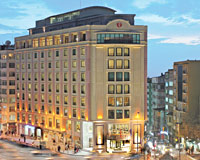
"It used to be concentrated in İstanbul and other big cities," says Keloğlu, adding: "That is no longer the case. More and more luxury hotels and resorts are being built, especially concentrated along the Aegean and Mediterranean coastlines. They offer huge convention and conference facilities away from metropolitan cities."
Still, though, big cities like İstanbul, Ankara and İzmir are the obvious choice for convention planners and conference organizers as they are major attraction and entertainment centers. "As a result of the peak season being filled to capacity in İstanbul, we have seen new hotels appearing on the city's skyline," he said. In the last two years alone, almost 40 licenses to operate four- or five-star hotels have been approved. "This might ease the congestion and may alleviate the heavy demand on the hotel industry," Keloğlu notes.
Part of Wyndham Worldwide, Ramada operates four hotels in Turkey -- three in İstanbul and one in Ankara. Keloğlu explains that the chain has 6,550 hotels with 551,000 rooms and is active in 59 countries in six continents. "We are both a business and leisure hotel company," he stresses. Ramada resorts specifically target leisure travelers while Ramada Hotel and Suites provide luxurious amenities to both business and leisure travelers. Ramada Encore, conversely, is designed for budget travelers and offers economical and competitive rates.
He underlines that the major obstacle the industry faces in Turkey is the lack of legislation regulating it. He also complains about increasing energy prices that impact their cost structures. Despite these concerns, Keloğlu is committed to doing their best to help Istanbul's preparations to become a European Capital of Culture in 2010. "In the first eight months of 2008, Turkey received 4,781,000 tourists," he notes. Keloğlu says there is a recession in some countries, including Turkey, but is hopeful that measures taken to overcome the crisis will yield productive results.


