

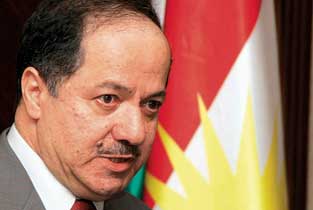
Following meetings between Turkish delegations and Barzani, the latter's Kurdistan Democratic Party (KDP) and Iraqi President Jalal Talabani's Patriotic Union of Kurdistan (PUK) gathered and agreed to develop a new strategy against the PKK, which also has bases in northern Iraq, the daily said, citing Iraqi sources.
The new strategy will be implemented as " federal Kurdish region policy" but not as policies of the KDP or the PUK, it reported.
" A fundamental principle on which Ankara and Arbil agree during meetings will be the backbone of this new strategy. According to this, regional authorities will convey to the PKK their requests for 'abandoning the federal Kurdish region's soil, not to resort to actions and lay down arms,'" the report said, noting that Iraqi regional officials would focus on the idea that the PKK's armed struggle has been harming the Kurdish struggle in Iraq and other places.
As part of the new strategy, the Iraqi Parliament will declare the PKK as " illegal," Taraf said. The reason for not labeling the PKK as " terrorist" is to be able to " conduct contacts with the organization on various precautions including laying down arms," Iraqi sources told Taraf.
The United States is cooperating with Turkey by providing intelligence about the PKK in Iraq and allowing Turks to use Iraqi airspace for aerial strikes on PKK targets in the northern part of the country. The Iraqi central administration in Baghdad also condemns the PKK attacks but says it has little power in the Kurdish-run north to curb them.
Turkish Foreign Minister Ali Babacan said in October that the Iraqi Kurds could be part of a three-way mechanism if the Baghdad administration agrees. Babacan also said then that Ankara was considering tripartite consultations with the United States and Iraq on ways to curb the PKK, as proposed by Talabani in a phone conversation with his Turkish counterpart, Abdullah Gül, after an Oct. 3 attack by the PKK on a military outpost located near the border that left 17 soldiers dead.
Last month, during a meeting in Baghdad, senior Iraqi, Turkish and US officials formed a joint committee to combat the PKK. Then, the trilateral meeting was also attended by two representatives from the regional Kurdish administration in northern Iraq, including regional Interior Minister Karim Sinjari.
The trilateral meeting and Babacan's remarks followed a meeting in Baghdad between a Foreign Ministry delegation headed by Turkey's special envoy for Iraq, Murat Özçelik, with Barzani. The meeting broke a taboo in Turkish foreign policy following several years during which Ankara refused to have talks with the Kurdish administration, accusing it of supporting the PKK.


