

India said the 10 militants who rampaged through its financial capital killing 171 people were not only from Pakistan but were also controlled from within that country. If Pakistan fails to act swiftly against those responsible, India has threatened to pull out of a nearly five-year-old peace process between the nuclear rivals.
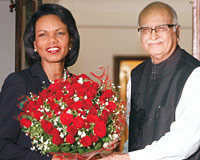
"This is the time for everybody to cooperate and do so transparently, and this is especially a time for Pakistan to do so," Rice told a press conference in New Delhi. Separately, the top US military commander flew into Islamabad urging Pakistan to broaden its campaign against jihadi groups following the attacks in Mumbai.
Admiral Mike Mullen, the chairman of the US Joint Chiefs of Staff, urged Pakistan to "investigate aggressively any and all possible ties to groups in Pakistan" and "take more, and more concerted, action against militant extremists elsewhere in the country."
Rice also warned India not to take action that would provoke "unintended consequences". Analysts have warned that an escalation in military tensions in South Asia could distract Pakistan from the battle against militants on its Afghan border, or undermine its civilian government. About 10,000 protesters blocked traffic in Mumbai and shouted slogans in the biggest public expression of anger so far since the attacks. Most of it was directed at the government security failure, along with Pakistani involvement.
"I have come with my friends because we can not take it any more. The politicians must act, they must stop taking us for granted," trader Mahesh Patel said.
"Down down Pakistan, attack Pakistan!" some shouted angrily. "Hail India! Shame shame politicians!"
Rice cut short a visit to Europe and flew to India as tensions soared in South Asia. She is expected to visit Pakistan as well, officials in Islamabad said.
"We have to act with urgency, we have to act with resolve and I have said that Pakistan needs to act with resolve and urgency and cooperate fully and transparently. That message has been delivered and will be delivered to Pakistan," Rice said. Later she added that even if "non-state actors" had carried out the attack, it would still be Pakistan's responsibility to take "direct and tough action" against them. But Pakistan President Asif Ali Zardari told CNN that he had been given no tangible proof that the surviving gunman was a Pakistani, and that he doubted the Indian claim.
Zardari also signaled he would not accept an Indian demand to hand over 20 of its most wanted men that New Delhi says are living in Pakistan, saying if there was any evidence, they would be tried by his country's judiciary.
"I don't want to get into the specifics of what Pakistan may or may not do, but I am going to take as a firm commitment Pakistan's stated commitment to get to the bottom of this and to know these are enemies of Pakistan as well," Rice said.
India has long said Pakistan is unable or unwilling to act against anti-India militant groups there. The latest attacks risk unraveling improved ties between the adversaries, who have fought three wars since independence from Britain in 1947.
With an election due by May, Indian Prime Minister Manmohan Singh is under pressure to craft a muscular response to opposition criticism, which has intensified since the attacks, that his ruling Congress Party coalition is weak on security.
Indian Foreign Minister Pranab Mukherjee said military action was not being considered but warned that a peace process begun in 2004 was at risk if Pakistan did not act decisively.
"I informed Dr. Rice there is no doubt that the terrorist attacks in Mumbai were perpetrated by individuals who came from Pakistan and whose controllers are in Pakistan," he said.
Explosive devices defused at Mumbai train station
Explosive devices were found and defused at Mumbai's main railway station on Wednesday, Indian television channels reported. The station was one of the sites attacked last week by militants. Police said a bomb squad was at the station but nothing had yet been found. Maharashtra state chief minister Vilasrao Deshmukh was due to visit the station, NDTV reported. CNN/IBN said the device could have been planted on Nov. 26, the day that the attacks on Mumbai started. New Delhi Reuters


