

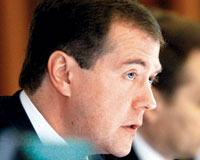
" Attempts to expand the military infrastructure of NATO near the borders of our country are continuing," Medvedev told an annual meeting with the Defense Ministry's staff.
Russia has described plans by the previous US administration to grant NATO membership to ex-Soviet Ukraine and Georgia, and to deploy elements of a US missile shield in Eastern Europe, as a direct threat to its national security.
Moscow has said it appreciates US President Barack Obama's intention to give their ties a fresh start, though Medvedev, who will meet Obama in London on April 1, has said he expects Washington to match declarations with deeds. Medvedev told Russia's top military brass that the prospect of NATO's expansion, combined with a threat of local crises and international terrorism, " requires a modernization of our armed forces, giving them a new modern shape." He said Russia had the resources to fund this modernization, despite the current economic crisis.
" The primary task is to increase the combat readiness of our forces. First of all, our strategic nuclear forces. They must be able to fulfil all the necessary tasks to ensure Russia's security," Medvedev said.
" Another task on our agenda is the transfer of all combat units into the category of permanent readiness." Medvedev said the large-scale modernization of the army and navy would begin in 2011.
In a another development, a panel of former high-level American diplomats and members of Congress on Monday urged the United States to seek Russia's close cooperation in dealing with Iran and solicit Moscow's participation or at least acquiescence to a missile defense system in Europe.
Calling for across-the-board repairs to a splintered relationship with Russia, the commission took note of some recent positive trends. But the panel warned that " we are deeply concerned by the gap between the current US-Russian relationship and the level of cooperation that the United States needs with Russia in order to advance vital American interests."
The commission, headed by former Sens. Chuck Hagel, a Republican, and Democrat Gary Hart, is a joint project of the Nixon Center, a Washington think tank, and the Belfer Center for Science and International Affairs of Harvard University. Describing current relations as " deeply troubled," the commission said, however, Moscow is not hostile to the United States, " at least not yet."
Even if the relationship breaks down completely, Russia does not have the will or the resources for a new Cold War, the report said. REUTERS/AP MOSCOW


