

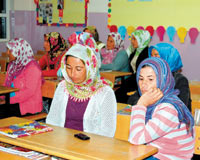
After the law went into effect, the Public Education Center in Bozova received a considerable number of requests for German-language courses. Eventually three separate German courses were opened in the villages of Hacılar, Deliler and Sığırcık, the Anatolia news agency reported over the weekend.
Many people from Bozova have immigrated to Germany, Halit Erdem, director of the Public Education Center, told Anatolia, noting that many of these young immigrant men wanted to marry girls from their hometown. Erdem added that the new immigration law in Germany put the girls who are engaged to these immigrants in a difficult situation.
" We have opened courses in order to remove this difficulty and aid family unity. Interest in the courses -- which are held for two hours every evening and will continue for three months -- is high. Those who successfully finish the courses will take a language test at the German Embassy in Ankara," Erdem said.
Some 2.5 million people of Turkish descent live in Germany, more than in any other country in Western Europe. While some are well integrated into German life, others live in separate urban communities, speak only Turkish and stick to old traditions.
When it was passed, Germany's new immigration law sparked harsh reactions both from the Turkish government and from the Turkish community in Germany.


