

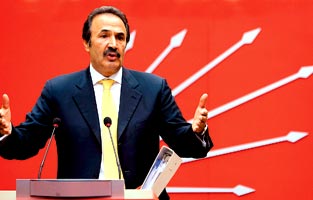
CHP İstanbul deputy Ali Topuz, in a statement he made to Today's Zaman, said he and other members of the opposition were remaining silent for the time being to avoid damaging the party's reputation. However, he said the incident had dealt deep wounds to the party that would be hard to heal.
Topuz, a member of the parliamentary Political Ethics Commission, which was recently founded on the initiative of Parliament Speaker Köksal Toptan, said he was most worried about CHP leader Deniz Baykal and his team owning up to Sevigen's wrongdoing. "My heart's aching, and I am ashamed. Nobody has the right to put CHP members in such a difficult position, to make them ashamed as such. The Sevigen incident is not a commercial deal. It is about using your position and title for personal gain; it is about excessively high financial gain. He should be forced to resign, which wouldn't be enough. He should be expelled from the party. This can't be covered up by saying, 'This is a conspiracy.' Such an attitude means implicit acceptance," he said.
Haluk Koç, one of the most outspoken rivals of Baykal inside the CHP, held a similar stance. "I am not speaking now in order to avoid harming my party during the local elections process. But we will have much to say once the elections are over," he said. The CHP's intra-party opposition plans to agree on a candidate to challenge Baykal's leadership and force the CHP to hold a party congress.
Accusation against Mehmet Sevigen According to statements made earlier this week by Özhan Erem, a businessman who bought a piece of land in İstanbul's Beşiktaş district in 1997 during Prime Minister Recep Tayyip Erdoğan's term in office as mayor, Sevigen was part of a scheme to force him to sell the land. Erem claimed that shortly after he bought the land, its zoning plans were changed by the municipality, designating the land as a park or green area. The businessman sued the municipality to change the new zoning plan for the area, eventually receiving a permit to erect a 12-story building. Exhausted from an eight-year legal battle, Erem decided to sell the land, when the CHP's Sevigen contacted him. Through Sevigen, Erem struck a deal with a businessman named Mehmet Emin Erkan, a close friend of Erdoğan. Sevigen allegedly received more than $1 million for his role in the deal. Shortly after the sale, the zoning plan Erem failed to change for many years was changed in three months with the support of the AK Party-dominated Metropolitan Municipal Council and its CHP members. The new permit allowed a building of up to 23 stories, Erem claimed. Currently, the site hosts a 23-story plaza called the Selenium Panorama. |
CHP Gaziantep deputy Yaşar Ağyüz also told Today's Zaman that Sevigen should resign immediately, warning that storms could rage inside the party over the Sevigen affair after the local elections if he does not do so. "Every politician has to protect the interests of the party during election time. A deputy who has done something unethical should do what must be done. I think he is late in resigning. Even if he resigns tomorrow, it will be too late. March 29 is very important for us; we don't want to harm our party. This is why our mouths are shut until that date," Ağyüz explained.
Ethics-check in Turkish politics
Meanwhile, the newly founded Political Ethics Commission, will focus on setting rules and guidelines to define what constitutes ethical behavior for politicians and will keep an eye on behavior that might be considered unethical conduct.
The commission, made up of Justice and Development Party (AK Party), CHP, Nationalist Movement Party (MHP) and Democratic Society Party (DTP) members, will start work after the municipal elections. The commission will examine allegations and accusations of unethical conduct against deputies and issue resolutions on each case. The commission members are Salih Kapusuz (AK Party), Ali Topuz (CHP), Nevzat Korkmaz (MHP) and Selahattin Demirtaş (DTP).
However, there are still some legal resolutions that must be adopted before the commission is able to start its work. Once those resolutions are passed, the commission will have the authority to request all kinds of information and documents regarding deputies from Cabinet members appointed from outside Parliament as well as from public agencies.
The commission has already drawn up some new guidelines for deputies. According to the draft rules, the confidentiality of financial asset declarations by deputies will be lifted. Deputies and ministers will not be allowed to take on any responsibilities at state or public agencies or affiliated institutions, nonprofit organizations or workers' unions. They will also be banned from direct or indirect contract work in any field. The only exceptions to this will be if a deputy is assigned to a temporary post in addition to parliamentary duties by the Cabinet, which will be limited to six months. ERCAN YAVUZ ANKARA


