

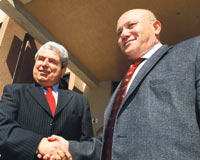
But Christofias' February election, ousting hard-liner Tassos Papadopoulos, boosted hopes for peace, and both leaders moved quickly to restart the peace process. In April, they reopened a busy shopping street in the heart of the divided capital of Nicosia, removing barricades that symbolized the estrangement of the two communities. But the talks have not lived up to hopes of a swift agreement as both leaders confront the complexities of issues such as security guarantees and the thorny issue of property rights.
In nine meetings so far, Christofias and Talat have not moved beyond discussions on power-sharing under a future federation, and Christofias has said he doesn't see the power-sharing talks wrapping up before year's end. " We must examine other chapters of the negotiations to be able to judge where we stand and how far we can go," government spokesman Stefanos Stefanou said on Wednesday.
Talat has said the two sides are at odds over the division of executive power. Christofias' top aide, George Iacovou, said " some distance" separates the two sides over how federal government should function. Turkish Cypriots seek a more devolved union to avoid domination by the majority Greek Cypriots, who want a strong federal government to prevent any agreement from unraveling into permanent partition.
The UN, seeking to keep things moving, is stressing that there is progress in the talks, despite more reserved Greek Cypriot assessments. But UN officials are cautious not to set any deadlines. " I think obviously the process will go into 2009, but as long as momentum is sustained, they can achieve a good solution in the end," Downer said.


