

Wednesday's court order against Chen has implications far beyond Taiwan, where he is reviled by millions for his apparent tolerance of corruption, but lionized by millions of others for his willingness to stand up to both Chinese threats and American opposition to his anti-China line. Chen, who has denied any wrongdoing in the corruption case against him, is an ardent supporter of Taiwanese independence, a cause decried by Beijing, which insists that Taiwan is part of Chinese territory. China has threatened war if the island moves to make its 59-year break with the mainland permanent.
Under Taiwanese law, Chen can be detained for up to four months. His detention does not constitute a formal indictment.
Chen was being kept in solitary confinement on his request, and that during his detention the former president would only be known by his assigned number, 2630, CTI Cable News quoted unidentified jail officials saying.
Legal proceedings against Chen -- including a prosecutorial interrogation -- extended for nearly 21 hours from start to finish.
They were interrupted for several hours after Chen complained that he had been injured while being transported from a prosecutors' office in downtown Taipei to the nearby court building. He was returned to the court after doctors found he had sustained only a minor muscle tear that required no special treatment, said court spokesman Huang Chun-ming. In addition to incensing China, Chen earned repeated criticism from the United States, Taiwan's most important foreign partner. Despite shifting its diplomatic recognition from Taipei to Beijing in 1979, Washington remains committed to helping the island defend itself against a Chinese attack. During Chen's just concluded presidency, it saw him as a loose cannon who could well provoke a Chinese invasion across the 100-mile-(160-kilometer)wide Taiwan Strait.
Chen himself denies any insinuation that his pro-independence policies are provocative.
He defiantly predicted his arrest late Monday, and then early Tuesday, attempted to link it to alleged attempts by newly installed Taiwanese President Ma Ying-jeou to placate China in the wake of violent protests last week against a visiting Chinese envoy.
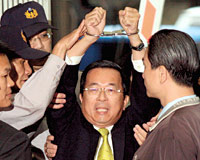
"Long live Taiwanese democracy," Chen declared to his supporters outside the prosecutors' office in downtown Taipei. "Long live Taiwanese independence." Li Yihu, a Taiwan expert at Peking University in Beijing said Chen's prosecution is not related to China in any way. "It is a case involving a great amount of money and has had a negative influence, so it must be dealt with," he said. "It is nothing to do with placating the mainland." Led from the prosecutors' office in handcuffs Tuesday afternoon en route to a waiting vehicle and the drive to Taipei District Court, Chen blamed the Ma administration for his troubles.


