

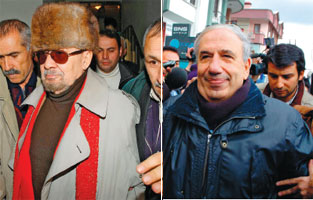
Retired Gen. Erdal Şenel was among those detained yesterday. Þenel, a former legal undersecretary at the General Staff, has allegedly been involved in the blacklisting of military personnel based on their religious practices. He is remembered for being close to retired Gen. Hurşit Tolon, who was detained
earlier in the course of the investigation. He has also been accused of being behind the controversial dismissal of Col. Mustafa Kahramanyol from the army. Shortly after Kahramanyol was dismissed, his wife claimed she had been offered money from a Turkish Armed Forces (TSK) general to lie about her
husband's religious affiliation and refer to him as a reactionary. Kahramanyol took his case to the European Court of Human Rights, which found no valid
reason for his dismissal.
Former İstanbul Mayor Bedrettin Dalan was also detained yesterday. Dalan started a new foundation called İstek after he quit politics. İstanbul's Yeditepe University, which was founded by the Ýstek Foundation, has hosted a number of academics who were later arrested during the Ergenekon investigation.
The deputy president of the Special Operations Unit at the National Police Department in the late '90s, İbrahim Şahin, was also detained. During his term in office Şahin set up a special counterterrorism team. His name was implicated in the Susurluk investigation of 1996, which came after an accident that revealed shadowy links between a police chief, a politician and the criminal underworld. Şahin was a close friend of Abdullah Çatlı, a former ultranationalist youth leader who was involved in a number of secret operations abroad and also in Turkey. Çatlı died in the Susurluk accident when he was being sought on an international warrant.
Şahin had also testified before the parliamentary commission investigating the Susurluk affair. He was tried in 1997 on charges of forming a gang in the Susurluk trial. He was released in September of that year.
Professor Yalçın Küçük, who started his academic life in 1966 at the Middle East Technical
University, spent long years contributing to leftwing journals such as Direction (Yön), Labor (Emek) and the Oath (Ant). He argued that Turkey needed a national democratic revolution, a movement propagated in the '60s by some members of the Turkish Workers' Party (TİP) who called for a socialist revolution that would be initiated by a military takeover. In the later stages, the revolution would establish the dictatorship of the proletariat, leaving no room or need for violence later on. He was expelled from his university office first in the March 12, 1971 military intervention and once again during
the Sept. 12, 1980 coup.
He left Turkey in the year 1993 and moved to France in protest against Süleyman Demirel being elected as president and Matild Manukyan, an elderly businesswoman who made her fortune as a brothel owner, becoming the top taxpayer of the year. Also in that year he had a meeting with outlawed Kurdistan Workers' Party (PKK) leader Abdullah Öcalan. Küçük was allegedly the person who saved Öcalan from an attempt on his life in 1996. Küçük hosted a number of programs for the PKK television channel MED-TV.
He returned to Turkey in 1998, after the Feb. 28 period, and was sentenced to two years in jail for promoting " Kurdism." In 2000 he was released. He started hosting the Pens and Swords program on SKYTÜRK, which was later ended by the channel's executive board.
Küçük had some unusual opinions about the Kurdish administration in northern Iraq, referring to it as a Kurdo-Judaic state. He argued that unless Turkey enlarged its borders by conquering the northern Iraqi towns of Mosul and Kirkuk, it would also lose the city of Diyarbakır to a new Kurdish state that would be established there. Küçük is also an in-law of Professor Ergun Özbudun, who ironically headed a commission set up by the Justice and Development Party (AK Party) to draft a more democratic constitution.
Higher Education Board (YÖK) President Kemal Gürüz, a very ardent supporter of the headscarf ban in universities, was also detained in yesterday's raids. Gürüz had stated that headscarved students should not even be allowed to walk on the streets and that they should leave the country and move to Saudi Arabia.


