

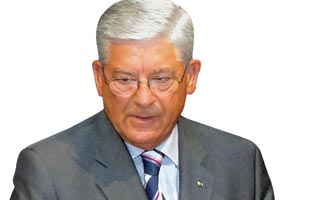
When an İstanbul court on Saturday released Tolon, who has been in prison for the past seven months pending trial, critics raised questions about the reasoning and motives behind his discharge.
According to the İstanbul 12th Higher Criminal Court, the evidence against Tolon was "insufficient." Explaining the reasoning behind the release, the court said Tolon's possession of a copy of a 29-page booklet allegedly showing the structure of Ergenekon, which was listed as the prosecution's primary evidence against him, could not be accepted as convincing evidence to establish that Tolon was a senior member of the criminal organization because the same document has been published by a number of publishing houses and is available on many Web sites. However, Tolon was arrested not for possession of a copy of the booklet but for "establishing and managing the Ergenekon terrorist organization."
A close look at Tolon's lawyers' efforts reveals that they applied to İstanbul's 9th, 12th, 13th and 14th Higher Criminal Courts to demand Tolon's release, after each court in turn rejected their demand. Tolon's attorneys then reapplied to the 12th Higher Criminal Court, which in its first rejection had indicated that there was no need to fear that Tolon would " escape from justice" or " obscure the evidence" even though the court could not find enough support for Tolon's release.
Tolon's lawyers went to the 12th Higher Criminal Court again when it was that court's turn to be on call, and this time the court ruled that Tolon's health should be evaluated by the Forensic Medicine unit because his lawyer had demanded he be released due to high blood pressure and general health complaints. The Ergenekon prosecutors appealed the decision, but the 12th Higher Criminal Court persisted with its ruling. When the Forensic Medicine unit sent in its report, the 9th Higher Criminal Court was on call and once again rejected the demand for Tolon's release. Tolon's lawyers reapplied to the 12th Higher Criminal Court when it was on call once again, and the court then granted his release.
Developments surrounding the Tolon case become even more complicated when one takes into account his attempt to arrange a false report asking for an additional examination at the Gülhane Military Academy of Medicine (GATA), where he would be able to receive a medical report that would ensure his release. Tolon was hospitalized last September for high blood pressure and weight loss. Tolon later attempted to be transferred to GATA through a falsified medical report. He finally managed to be referred to the military hospital in January of this year.
'Tolon not acquitted'
Ergin Cinmen, the lawyer who organized the " One Minute of Darkness for Light Forever" protest after the 1996 Susurluk incident, a car accident that exposed links between the Turkish state, the criminal underworld and security forces, has said some media organizations have interpreted the court's decision as though Tolon had been acquitted even though he is still being investigated as part of the Ergenekon case.
" Although the reasoning related to his release is misleading, his release is lawful. He is banned from international travel. His trial is pending. The progress of the investigation in relation to his ties to the Ergenekon organization is continuing," Cinmen told Today's Zaman.
Cinmen added that some in the public have questioned the motives behind his discharge, but he refrained from commenting on those motives, saying that the issue is " too speculative."
Upon Tolon's release from prison, the Hürriyet daily claimed that other suspects in the Ergenekon case are likely to use the " Tolon criterion" to demand a release from prison.
On the other hand, retired military judge and lawyer Ümit Kardaş points out that Tolon's release may have more to do with the military pressure exerted on the government, which is behind the investigation into Ergenekon.
" There is a growing lack of confidence in the investigation into Ergenekon because there is a growing suspicion about the military's pressure as the investigation has progressed," Kardaş told Today's Zaman, referring to the firm stance of the military in support of some Ergenekon suspects.
For example in February of last year, Kocaeli Garrison Commander Lt. Gen. Galip Mendi paid a visit to Tolon and another Ergenekon suspect, Gen. Şener Eruygur, who were being held in Kandıra Prison at the time.
Eruygur, a former head of the Gendarmerie General Command (JGK) and former chairman of the Atatürkist Thought Association (ADD), was released from prison for health reasons last September.
Another symbolic display of support by the military took place when the top brass gathered to show their solidarity at the funeral of Col. Abdülkerim Kırca, a commander in JİTEM -- a clandestine and illegal gendarmerie intelligence unit whose existence has been officially denied -- who killed himself in January following several Turkish newspapers' publication of numerous allegations from families of the victims of hundreds of unsolved murders, accusing Kırca of being behind most of the murders committed in eastern and southeastern Turkey in the '90s. An upsurge in the number of unsolved deaths in the region coincides with the time he served there as a major.
The General Staff not only stood behind Kırca, but also warned the media against publishing accusatory stories revolving around his suicide.
Kardaş recalled that one of the most important aspects of the Ergenekon investigation is finding the persons responsible for the atrocities in the Southeast.
" Kırca had been under scrutiny for the last four years. The military should have at least remained neutral to his death," Kardaş said. " The impression that the military is giving is that this is as far as you can go in the Ergenekon investigation. Stop here."
The military's influence
Star daily chief columnist Mehmet Altan titled his Sunday article " There is no longer a four-star general under arrest," pointing out the danger that the military may pressure the government not to delve too deeply into the Ergenekon case.
Altan recalled that another retired general who was detained in another wave of Ergenekon operations on Jan. 7 was Tuncer Kılınç, a former Defense Ministry undersecretary and former National Security Council (MGK) secretary-general. Kılınç, who was allegedly leading and training the military cadets who would participate in a military takeover of the government, was released following the meetings of Chief of General Staff Gen. İlker Başbuğ with both President Abdullah Gül and Prime Minister Recep Tayyip Erdoğan in addition to his top commanders.
According to Altan, those meetings may have been attempts to satisfy military officers who were spooked by the detentions.
Sabah daily columnist Mahmut Övür said he expected ups and downs in the investigation into Ergenekon because the structure of the status quo in Turkey is so unyielding.
" I expected such highs and lows in the Ergenekon investigation process," he said, adding that military's stance in support of Kırca is a matter of serious concern.
However, he told Today's Zaman that the process that was interrupted during the Susurluk investigation is going to continue in the Ergenekon case because there is political will behind the current investigation.
" The military may be firm in some stages of the investigation, but that does not mean there will not be a face-off," he said.YONCA POYRAZ DOĞAN İSTANBUL


