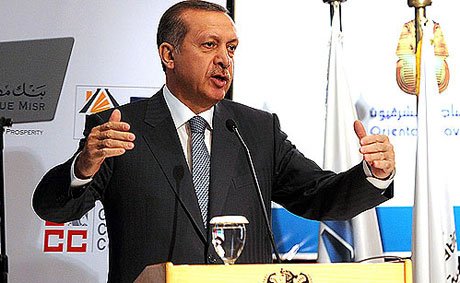
Turkey expects to double its bilateral trade volume with Egypt to $10 billion in three to four years, Prime Minister Recep Tayyip Erdoğan told a meeting in Cairo on Sunday.
Erdoğan is visiting Cairo accompanied by 350 businessmen and 10 ministers from the Cabinet, one of the largest presences in such a visit in recent years. On Sunday, Erdoğan participated in an Egypt-Turkey Business Forum in Cairo, where he reiterated Ankara was ready for closer business ties with Egypt. “We have increased our trade with North Africa by as much as nine-fold to $45 billion in 2012 from $5 billion back in 2002. … Likewise, tourists from this region to Turkey jumped by six-fold in the same decade. We expect this increasing cooperation to boost trade with our Egyptian brothers,” Erdoğan told the meeting.
Underlining that the Turkish government stepped up its efforts to cement ties with the new Egyptian leadership following last year's revolution, which toppled former President Hosni Mubarak, Erdoğan said these will yield fruits in the months to follow. “We have signed 27 separate agreements on cooperation with Egypt and expect approval from both countries' parliaments. … These deals will help further improve our ties.”
Underlining that Turkish firms had faith in Egypt's future as a fast-developing market, Erdoğan said more entrepreneurs from Turkey sought investment opportunities in the North African country. “The arrival of 350 businessmen is the proof of the importance we attach to Egypt. We have gone through hard times -- the 2011 uprising -- together in the past,” he explained.
There are 300 Turkish businessmen who currently have investments in Egypt, and many of these projects focus on the construction sector. Reiterating this factor, Erdoğan said Turkish contractors have reached a total business volume of $200 billion with projects in 94 countries, placing Turkey on the second spot on a list of countries carrying out overseas construction projects after China. “Around 40 percent of Turkish construction projects abroad are in North Africa and the Middle East, and Egypt has a critical place here,” he noted.
Trade with Egypt to hit $10 bln in 3-4 years, Erdoğan says
Turkey expects to double its bilateral trade volume with Egypt to $10 billion in three to four years, Prime Minister Recep Tayyip Erdoğan told a meeting in Cairo on Sunday.