

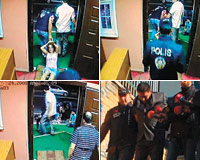
The scenarios of the exercise, called " Güven 2008" (" Trust 2008" ), which started Monday and will last for five days, target crisis and precautions in a possible catastrophe involving terrorist attacks. In addition to the MGK and the Prime Ministry, 210 personnel from 15 ministries, 25 institutions and the provinces of Adana, Ankara, Diyarbakır, İstanbul, Kocaeli, Mardin, Mersin and Şırnak take part in the exercise, which is held at the Prime Ministerial Crisis Administration Center (BKYM).
MGK Secretary-General Tahsin Burcuoğlu said this year's exercise goes beyond covering traditional threats.
" This year, on the fourth day of the exercise, to improve the capabilities of the country in terms of chemical and biological threats, civil institutions in Ankara, Kocaeli and İstanbul will participate with the Turkish military in the exercise of chemical, biological, radiological and nuclear threats," he said, adding that the concept of " national security" has been expanded in the face of today's threats.
" With the end of the Cold War, conventional forms of military threats have largely decreased, but the old threat has been replaced by terrorism, ethnic conflicts, the spread of weapons of mass destruction and technological threats," he said. " In other words, asymmetric threats, as we call them."
The exercise teams started the training by watching a film showing a series of attacks and threats occurring in a period of 10 days. Then the BKYM rapidly evaluates the situation, gives briefings and warns all necessary units to take action.
The crisis center works to deal with a crisis situation in the most effective way. For that purpose, the Crisis Coordination Council can be headed by either the prime minister or a state minister. The council can take a political decision, such as announcing a war, declaring an extraordinary situation and starting mobilization campaigns. The council was given more powers after the 1999 earthquake in the Marmara region.
The exercise will also cover such subjects as energy security, population movements, cyber threats, " genocide" allegations and trafficking of human and narcotics.


