

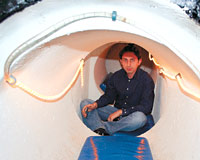
Atilla Ünal, a researcher from the TÜBİTAK Marmara Research Center (MAM) Turkey-Ukraine Joint Research Laboratory, told the Anatolia news agency that the potential for search-and-rescue radar to be used after earthquakes was developed a few years ago and that work toward producing such a tool began then. For other radar systems to detect victims underneath rubble, the victims must make noise or motion, Ünal said.
" The [new system] works even in situations where the victims are unconscious or in a position where they can't make any noise. As long as they're alive, this system allows for the easy determination of their location," he said, adding that the radar made use of electromagnetic fields, which does not present any dangers to human health.
Ünal explained how the system worked: " With the radar, a sweep is done of a specific region on the electromagnetic field and a signal is returned. It communicates with a remote laptop and Bluetooth device, and the signals are thus detected. If a person's heart is beating, it can detect this through layers of rubble. At 10 kilograms, the radar is easily transported."
The researcher noted that the new technology would be an immense improvement on the imprecise method search-and-rescue teams have previously had to resort to post-earthquake -- calling out, " Is there anybody down there?" and using radar employing ultrasound technology that requires people to move to be detected.


