

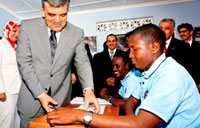
Turkish President Abdullah Gül's high-profile visit to the Kenyan capital of Nairobi on Friday and later to Tanzania, accompanied by more than 120 businessmen, represents the latest attempt by Turkish officials to boost trade relations with Africa. Gül's official three-day visit, the first by a Turkish president to sub-Saharan nations, came after Turkey hosted the Africa Summit in İstanbul last August, during which a framework for development and cooperation between Turkey and Africa was adopted.
The trip is also a way to thank African countries for supporting Turkey's bid for a seat on the UN Security Council, which began in January and is set to last for two years. " We have responsibilities in Africa. Sixty percent of issues on the agenda of the UN Security Council are related to Africa, including unresolved political issues, security issues and humanitarian issues. ... As a member of the UN Security Council, we have to closely know and deal with these problems," Gül said before departing for Kenya.
Adopting a policy of diversifying trade markets, Turkey is targeting $50 billion in trade with the African continent by 2013. The warm welcome the Turkish president received during his visit to Kenya and Tanzania is indicative of strengthening ties |
Diversifying trade markets and seeking more export opportunities seem to be providing a breather to Turkish businesses hurt by crisis-driven contraction in European and US markets, Turkey's traditional trading partners.
Thanks to the opening up of African, Eastern European and Asian markets spearheaded by the government along with trade groups such as the Turkish Confederation of Businessmen and Industrialists (TUSKON), many analysts say the Turkish economy has, to a certain degree, been able to cushion off the negative impacts of the global economic crisis.
Africa backs Turkish UNSC membership Turkey won wide support from African countries for its bid to get a non-permanent seat at the UN Security Council. It won the two-year membership at the powerful body with a sweeping vote of 151 countries in October and started serving as a non-permanent member of the Security Council on Jan. 1. Noting the African support for Turkey, President Abdullah Gül said before departing for his trip to Africa that Ankara has " responsibilities" to Africa. " Sixty percent of issues on the agenda of the UN Security Council are related to Africa, including unresolved political issues, security issues and humanitarian issues. ... As a member of the UN Security Council, we have to closely know and deal with these problems," Gül said on Friday. The government is eager to boost ties with African nations on a bilateral basis, too. Ankara plans to more than double its diplomatic presence in Africa by opening 15 embassies across the continent. Today, Turkey has 12 embassies and more than 20 honorary consulates in African countries. Gül is scheduled to oversee the formal opening of one of the 15 new embassies during his visit to Tanzania. Turkey's first ambassador to Tanzania, Şandar Gürbüz, is due to take up his mission in Tanzania's capital of Dar es Salaam. Gürbüz headed to Africa on Gül's plane on Friday. In April 2005 Turkey obtained observer status in the African Union (AU) and accredited its embassy in Addis Ababa as a representative to the union in May of the same year. At the union's summit, held in Addis Ababa in January 2008, Turkey was declared a strategic partner. Last summer, İstanbul hosted a Turkey-Africa Cooperation Summit in a bid to transform an already good relationship into sustainable cooperation. |
Despite the trade volume between Turkey and African countries hovering at low figures for quite some time, the last couple of years have witnessed a positive trend. Trade volume in 2003 amounted to $5.4 billion, before shooting up to $13 billion in 2007 and reaching close to $17 billion in 2008. Turkey's exports to Africa stood at $9.1 billion in 2008 -- up from $5.9 billion in 2007. A smaller growth rate was observed in Turkey's import figures; imports from the continent rose to $7.8 billion in 2008, up from $6.8 billion in 2007.
Turkey is said to be developing a new program that caters to African countries, especially those in the sub-Saharan region, with foreign direct investment (FDI) to boost trade. Kenya is an important hub and gateway to markets in the East African Community (EAC), with a population of 100 million, and the wider Common Market for Eastern and Southern Africa (COMESA), with a population of 500 million consumers. Turkish Foreign Trade Minister Kürşad Tüzmen was quoted as saying, "We are targeting $50 billion by the year 2012," at last year's TUSKON-organized trade bridge with Africa summit.
In Nairobi, Gül and Kenyan Prime Minister Raila Odinga signed a dozen protocols covering trade and economic development, aviation and the health sector. In a joint press briefing, they said that under the trade and economic development, Turkey would increase investments in infrastructure development, the textile industry, agricultural machinery and equipment, building, tourism, construction and pharmaceuticals, among others, while Kenya would export more produce to Turkey. The aviation protocol has already been put into effect and Turkish Airlines (THY) began direct flights to Nairobi on Friday. The airline will fly from İstanbul to Nairobi three times a week. Kenyan Airways will also be flying to Turkey on a weekly basis. In a symbolic move, both countries also signed an agreement lifting visa requirements for diplomatic passport holders.
To complement infrastructural development on mutual trade, Turkey has for some time now been providing technical assistance and educational programs to African countries, and new projects are under way to enhance these programs. The Turkish Foreign Ministry has decided to open new embassies and consulates in some African countries. It currently has 12 embassies and more than 23 honorary consulates throughout Africa. The Foreign Ministry opened a new embassy in Dar es Salaam during the president's visit to Tanzania. Turkey's first ambassador to this country, Şandar Gürbüz, accompanied the president on his trip.
In the meantime, the Trade Undersecretariat is also working to expand its representation at the attaché level in a number of countries. The Turkish Cooperation and Development Agency (TİKA) currently has three offices on the continent and would like to open new ones to support technical education in African countries.
TİKA's Nairobi office is already involved in development projects in Kenya and provides assistance to infrastructure projects. "These reforms are necessary in attracting foreign investors to this country, and I can assure you that through TİKA Turkey will invest in Kenya's economic development," President Gül said in Nairobi. The Turkish government is coordinating with the UN Habitat to renovate slum neighborhoods in Mombasa and is extending scholarship programs for Kenyan students. During his visit Gül also announced a donation of $1 million through the World Food Program toward Kenya's famine relief efforts. "Our relations are not only confined to economic development; we must all take moral responsibility to help each other in all social endeavors as a community of nations," the Turkish president said.
 |
 |
 |
 |
 |
 |


