

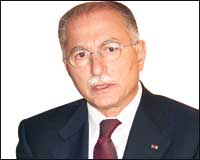
He said, "I am not accepting this award on my own behalf but on the behalf of my country." İhsanoğlu also stated that he believed the Islamic world would again reach the advanced stage it held earlier in history, but noted that a number of generations would have to pass for that to happen.
The contrast between science in the Islamic world in the 13th century and today is stark, İhsanoğlu noted. "In that time, Islam represented the most advanced cultural, scientific and civilization level. I am proud to be the first Turk in earning this medal. This is not, for me, given to me personally. I see this as an appreciation of the school that I represent and seek to improve. Unfortunately, we have turned into a nation that lost its traditions and rejected its own established practices. At some point, we denied our own traditions for reforms and laws for democracy. We had a Young Turk mentality that saw truth as the view held by a few people with everyone else having to accept that view. It was a subjective, unsubstantiated, simplistic and biased mentality that took everyone who accepted that particular view as good people and those who didn't as bad people. The work I have done in the past 30 years has challenged that understanding. And today, finally, my work has been rewarded by the International Academy of the History of Science. This shows that as long as we show patience on the right path, we will become an EU member and also enter into the top 10 countries in the world. The most important thing is that we don't exhaust our own energy fighting each other."
The OIC secretary-general also said there were conscious efforts in the Muslim world, particularly in countries such as Pakistan, Malaysia, Indonesia and Iran, to increase governmental spending on scientific research. "In one project, the OIC is ranking universities in 57 Muslim countries and picking the top 20 among those, and then we will work to make those 20 universities among the top 500 in the world."
On discussions on the place of Islam in Europe, İhsanoğlu said: "There is a question Europe has to answer. Is Europe a home, a motherland to Muslims, or is Europe a host for Muslims? This question is crucial. The history of Islam and Europe is centuries old. Islam has been in Europe since the time of the Andalus Empire and then continued its presence with the Ottoman Empire. Islam has contributed greatly to Europe, even in terms of science. Islam is the second largest religion in Europe today. Europe shouldn't fear Islam. This union should be ensured, and both Europe and Muslims have a responsibility to make this happen. We as the OIC are working for this. However, Europe has had no tolerance for difference in its history. Religious wars and conflict were directed at the Jews. There is intolerance against others in the genes of Europe. Europe, however, did improve in two aspects after World War II. One of these is the idea of the EU and accepting Judaism and the Judeo-Christian roots of Europe instead of rejecting it. What we are saying is that now it is time to make peace with us. I think we can do this on an intellectual basis and place it on a political fundament; a great portion of the problem will be solved. "
İhsanoğlu believes that one day Europe will accept Islam as one of the hosts of the continent, but this is not going to happen overnight. "We as the OIC are working for this in bilateral relationships with international organizations and countries. For example, we set up the Islamophobia Monitoring Center. We are not against freedom of expression. We are only against abuse of this freedom and profanity. We are against disrespectful insults to a religion deemed sacred by 1.5 billion people in the world. This is all we are saying," he explained.
İhsanoğlu also said there has been significant improvement in Europe in that department. "Instead of the insolent and snide attitude of the past, saying, 'We can't talk to you, we have different values and we don't care about yours,' there is a much more positive attitude. This is a very positive development."
İhsanoğlu said the OIC had applied to become an observer organization in the Union for the Mediterranean. He also said the OIC will become a part of people's daily lives through a number of projects, such as an Islamic calendar under development that will be designed to eliminate differences in calendars of various Muslim countries.


