

Although many agreed that as a member of Parliament, it was Arıtman's right to criticize Gül, the fact that she openly revealed her intention to attack the president, the person who represents the country, has been met with criticism.
Andrew Finkel, a British journalist covering Turkish politics for many years and a columnist for Today's Zaman, said there was a combination of factors that lead politicians to embrace unparliamentary language. "There are frequent television pictures of parliamentary brawls in South Asian politics. Fisticuffs seem to have an honorable place in Korean or Thai politics."
Looking back on recent years, he said it was not long ago that there were fights at party conventions in Turkey; during the 1990s there was a lot of throwing of plastic chairs at CHP and Motherland Party (ANAP, now ANAVATAN) party conferences.
"I remember attending one controversial vote in Parliament and witnessing the [now-defunct] Virtue Party [FP] members attacking [in the sense of rushing across the floor of Parliament] CHP members from İzmir who held up a sign mocking them. I think Abdullah Gül was one of them. I never saw him move so fast," Finkel told Sunday's Zaman.
On another such occasion, an independent deputy from the eastern province of Tunceli who is notorious for using abrasive language, Kamer Genç, astonished all with remarks about parliamentary deputies during a speech in İzmir last weekend. "You insult them in the strongest way possible from Parliament's podium, but they remain silent; they feel no embarrassment. They rob people; you tell them, and still they feel no embarrassment. There is only one way forward in such a situation: to shoot those deputies in the head," Genç said in statements met with criticism and largely interpreted as being provocative. Nevzat Tarhan, a professor of psychiatry also known for his research in social and political psychology, thinks the use of angry and unbecoming language by Turkish politicians could be due to several reasons.
According to the professor, an angry mood can be part of someone's character, urging them to react furiously and unexpectedly. In his view, such a mood is the signal of a politician's authoritarian leadership style, while a democratic leader's attributes would include persuasion through the use of temperate language. "Having such a mood is a shortcoming for a politician. It leads him/her to loneliness and wards off different opinions around them, leaving only people who unwillingly approve and praise that leader's actions out of fear," he said.
Another reason cited by Tarhan for the angry mood of politicians could be a feeling of despair, weakness and incompetence. The influence of group psychology can also play a role as some deputies often get carried away with each other's remarks in Parliament and find themselves in a fierce quarrel or exchanging blows with other deputies.
"If there are angry people in a party who show their reactions in a harsh way, they influence others to behave the same way. Some parties hold party congresses very peacefully without any incidents because there are no angry people in their ranks."
In September, Young Party (GP) leader Cem Uzan was convicted of insulting Prime Minister Recep Tayyip Erdoğan and was ordered by a court to enroll in an anger management program and read five books on "anger management" and "self development," a first in the history of Turkish politics.
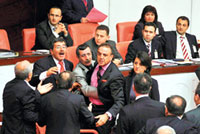
Most recently, last Friday, Parliament witnessed a fight between Democratic Society Party (DTP) deputy Sırrı Sakık and CHP deputy Mevlüt Aslanoğlu when the latter accused Sakık of being a "denouncer." After walking towards Aslanoğlu, Sakık tried to punch him and appeared to have hit him. Other deputies intervened, breaking up the fight. Deputy Parliament Speaker Meral Akşener ended the meeting, and DTP Deputy Chairman Selahattin Demirtaş went up to the rostrum and apologized on behalf of his party.
A former politician and a columnist for the Radikal daily, Hasan Celal Güzel, thinks it is a tradition for Turkey's politicians to adopt unparliamentary language as this has been the case throughout the history of the republic.
"But such political fights and language are not peculiar to Turkish politics as politicians of other countries are involved in similar situations," said Güzel.
According to Güzel, the reason why such bad and unbecoming language is widely used in politics is the main opposition CHP, which he says always resorts to non-democratic means for the settlement of parliamentary disputes.
Güzel agrees that the public sometimes approves of such actions by politicians depending on who the politician is and how he expressed his anger.
Before last year's July 22 elections, Prime Minister Recep Tayyip Erdoğan, who is frequently criticized for his angry outbursts, rebuked a farmer in the southern province of Mersin in front of cameras after the farmer had complained to him about his deteriorating financial situation due to government policies, saying, "You made my mother cry, prime minister." In response, an angry Erdoğan told the farmer, "Take your mother and leave," in remarks that were interpreted as very tough and not befitting a prime minister.
Although Erdoğan's opponents severely criticized him at the time and accused him of using insulting language against a citizen, his party ended up winning the general elections, receiving 46.6 percent of the nationwide vote.
Güzel said although the public generally disapproves of the use of tough language, they may welcome and enjoy it on certain occasions, as in Erdoğan's case, according to the situation and the person who used that language. "A smile could change many things," added Güzel.


