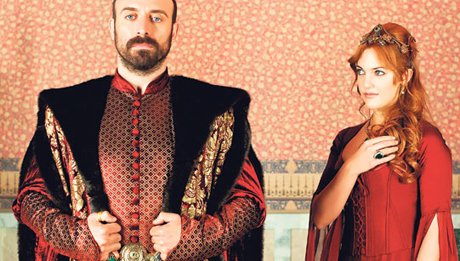
Remarks from Prime Minister Recep Tayyip Erdoğan severely criticizing a historical soap opera aired on Turkish networks, as well as in many Balkan and Middle Eastern countries, have become the top issue of debate in the Turkish media.
Prime Minister Erdoğan earlier this week offered his opinion on “Muhteşem Yüzyıl” (The Magnificent Century), a historical soap opera centered on the intrigues of the Ottoman Palace. Erdoğan and other conservatives feel that the series undermines the golden age of Turkish history, as it portrays Ottoman Sultan Süleyman the Magnificent, known as Kanuni in Turkish, who reigned from his coronation in 1520 to his death in 1566, in a way conservatives in Turkey say is skewed.
Erdoğan not only lashed out at the show but also at its producers as well as the owner of the network that runs it. “We know no such Kanuni [as portrayed in the series]. He spent 30 years of his life on horseback. I publicly condemn the directors of that show and the owners of the television station. We have warned the authorities about this. I expect the judiciary to make the right decision.”
The series has been running for two years. Erdoğan and other government representatives have occasionally expressed their annoyance with it, but this was the first time Erdoğan called on the judiciary to act against the show, sparking a huge controversy about free speech in Turkey.
The opposition swiftly spoke against Erdoğan's criticism. Republican People's Party's (CHP) Umut Oran submitted a question to Parliament, while CHP Deputy Chairman Erdoğan Toprak referred to the prime minister's call to prosecutors to act against the series as “grave, authoritarian and unhealthy.” He said the prime minister was giving direct orders to the judiciary. “What is more concerning is that the prime minister sees himself as having the right to interfere in everything,” he said. Oran's question, which demands an answer from Erdoğan, was a query about the constitutional duties of the prime minister, whether monitoring scripts of television series is part of the job description and whether Erdoğan's statement is not in violation of the principle of the separation of powers.
The Nationalist Movement Party (MHP) also criticized the prime minister. MHP Secretary-General İsmet Büyükataman accused the prime minister of trying to change the agenda of the country. “This is not the job of the judiciary,” he said, noting that historical inaccuracies in the show should be addressed by universities, historians and intellectuals of the country.
Peace and Democracy Party (BDP) parliamentary group deputy chairman İdris Baluken said the Justice and Development Party (AK Party) has consistently tried to exert its dominance over the world of arts, recalling that he had earlier called artists terrorists. He also said statements implying that the prime minister has “ordered” the judiciary to act were unacceptable. “Ordering the judiciary to censor something is a danger for democracy,” he said.
The show, mainly set in the harem of the Ottoman Palace, is very popular abroad as well. According to data from the Copyrights General Directorate of the Ministry of Culture and Tourism, “The Magnificent Century” attracts 150 million viewers in the Middle East, the Balkans and the Turkic republics. General Director Abdurrahman Çelik said Turkey currently exports television series to 76 foreign countries. “‘Gümüş' [Silver], ‘Kaybolan Yıllar' [The Lost Years] and ‘The Magnificent Century' find huge interest in foreign countries. In 2010, the exports volume earned from series shown abroad was $65 million. We expect this number to reach $90 million this year.”
The Supreme Board of Radio and Television (RTÜK) has fined the show twice, based on viewer complaints. The first fine was issued for “demeaning the values of society.” The broadcaster appealed against the fine in court, which upheld RTÜK's decision. The second fine was imposed over a similar alleged violation, which is also currently being appealed by the broadcaster. However, statistics indicate that the number of complaints from viewers has been declining.
“The Magnificent Century” is a high-rating show, with an estimated 20 million viewers tuning in every week. Taraf owner and Editor-in-Chief Ahmet Altan commented in an article published on Tuesday that people who had gathered to listen to the prime minister on the day of his speech fell silent -- as opposed to the regular applause -- when he chastised the series, calling on prosecutors to act.
There were many discussions both in newspapers and on television. Conservative columnist Fehmi Koru, who was the participant of a political show on television on Monday night, said the prime minister feels that the series portrays the woman at the harem as “loose women,” and is possibly disturbed by this. “But it has been said from the beginning that this is a TV series and it is fiction that doesn't directly correspond to history.” He also said, “I am of the opinion that the prime minister sees himself as the protector of the honor [of women].” However, he said he hoped that the prime minister will not insist on his call to the prosecutors. “He will let it go and the series will go on.”
There were also legal discussions on what the prosecutors can do to act, with lawyers indicating that the Turkish Penal Code (TCK) does not criminalize distorting history. “If there is no crime, there can't be any punishment,” said Cem Murat Sofuoğlu, a lawyer. Another lawyer and the head of the İstanbul Bar Association's Lawyer Rights Center, Ömer Kavili said: “The prime minister's comments are his exercising his right to criticize. What he doesn't have the right to do is to address the judiciary as head of the executive. The judiciary should be independent.”
As historians discuss how many years Kanuni really did spend on horseback, riding from battleground to battleground, the series has in fact created and increased awareness in the public of the period. Booksellers report booming sales in books about the era and particularly about Hürrem, or Roxelena, the beloved wife of Kanuni and a central character in the series.
Referring to this newfound awareness, İstanbul Culture and Tourism Directorate President Ahmet Emre Bilgili said the series has really influenced the outlook of citizens on historical figures. He gave the example of one visitor to the Süleymaniye Mosque, which hosts the tomb of Kanuni, saying the visitor prayed for Süleyman's soul while cursing the soul of Hürrem Sultan, whose tomb is next to that of the great sultan. He also said ordinary citizens now disdain şehzades, or the children of the sultans, because the series portrays them as young men interested only in women and sex.
Turkey debates soap opera that angered prime minister
Remarks from Prime Minister Recep Tayyip Erdoğan severely criticizing a historical soap opera aired on Turkish networks, as well as in many Balkan and Middle Eastern countries, have become the top issue of debate in the Turkish media.