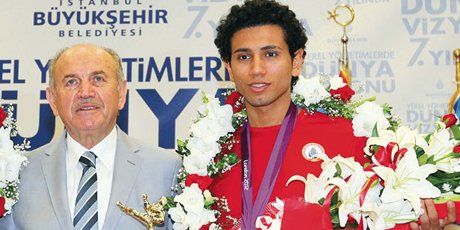
Turkey came home from the London 2012 Summer Olympics with only five medals -- two gold, two silver and one bronze.
The highlight, of course, came in the women’s Olympic 1,500-meter event in which Aslı Çakır Alptekin led a Turkish 1-2, holding off Gamze Bulut to clinch the gold.
This was a personal triumph, no doubt about it, for Aslı and Gamze, who have put Turkey firmly on the international athletics map.
But only five medals for a country like Turkey cannot be considered a success since the Turks had four long years to prepare for the London Games, and the officials all along had talked about achieving unprecedented success.
The Turkish contingent departed amid great fanfare and optimism for the London Olympics, which were held July 27 to Aug. 12. And with a record 114 athletes in 16 disciplines, the Turks had hoped for a far better performance this time around than in the previous Games in Beijing in 2008.
But that was almost delusional. Turkey was medal-less by Aug. 5 -- with only a week to go -- at the London Games. Badminton and table tennis players, swimmers, judokas, cyclists, archers, gymnasts, volleyballers and weightlifters were all eliminated in the opening rounds.
Come Aug. 6, and wrestler Rıza Kayaalp put a smile back on the faces of Turkish fans by winning a bronze in the Greco-Roman heavyweight (120 kilogram) division for Turkey’s first medal. The 22-year-old Kayaalp, a world and European champion, was up against Georgian Guram Pherselidze in the battle for bronze. The Turkish wrestler led 1-0 in the first round and maintained his dominance in the second to eventually win the bout 2-0.
And more was to come on Aug. 9, when Servet Tazegül won the men’s taekwondo featherweight (68 kilogram) gold medal -- beating Iran’s Mohammad Baghrei Motamed 6-5 in the final. Tazegül, also the reigning world champion, dedicated the victory and gold medal to his mother, who died earlier this year.
The following day, Aug. 10, was a day Turks will always remember. Aslı won the gold in the women Olympic 1,500 meters and Gamze the silver. Aslı looked powerful and strong, coming home in 4:10.23 and runner-up Gamze in 4:10.40.
Commenting on her historic victory, Aslı had this to say: “The lights were lit inside the stadium as the race took place at night. On the ground were spotlight shadows. Three shadows were visible before me in the last 100 meters. I was confused. I thought that the shadow on my right was one of my opponents, and I started to run faster to beat this opponent. When I looked at one of the screens, I realized that it was not an opponent but rather my own shadow. I was relieved to know that I was ahead of my opponents.”
And there was more on this glorious day, Aug. 10. Nur Tatar had to make do with the taekwondo silver after losing to defending champion Hwang Kyung-seon of South Korea in the women’s welterweight (67 kilogram) final.
Five medals altogether, not too good. But there is plenty of room for improvement ahead of the 2016 and 2020 Games, as Minister of Youth and Sports Suat Kılıç said.
Sultans make history
The “Sultans of the Net,” as the Turkish women’s volleyball team is called, came, saw, but did not conquer. Nonetheless, they made history by qualifying for the London Olympics. Though the Sultans did not get past the group stage, it was nevertheless an accomplishment. They became the first volleyball team, men’s or women’s, to represent Turkey at the Olympics and only the second time Turkey was represented in team sports. It was an important event in Turkish Olympic history.
Another important point worth mentioning is the underachievement of Turkish swimmers. Turkey is country surrounded by water on three sides, the Black Sea to the north, the Mediterranean to the south and the Aegean Sea to the west. And logic would suggest that this aquatic nation should produce some of the best swimmers in the world.
However, the disappointment of Turkish swimmers at the London Olympics and the World Short Course Championships in İstanbul earlier this month should give all those concerned serious food for thought.
It would not be wrong to say that Turks live in water. To borrow a line from Coleridge’s “The Rime of the Ancient Mariner,” Water, water everywhere, nor any medal in swimming.
Paralympians come to the rescue
Turkish Paralympians performed well at the London 2012 Summer Paralympics on Aug. 29 to Sept. 9 and thus made amends for the failures of their able-bodied counterparts.
The 69 Paralympians who took part at the London Games won one gold, five silver and four bronze -- an overall total of 10 medals. Four years ago in Beijing, 16 Turks took part and won only two medals.
Prior to the London Games, Turkey had only won four medals in the 20-year Paralympic history, and it serves to show that the 10 medals in London was no small feat.
But Minister Kılıç wants more and has called for greater improvement, saying that an increase from two medals in Being to eight in London was a positive step in the right direction but “not something to gloat about.”
Turkey fails to deliver at London Olympic Games
Turkey came home from the London 2012 Summer Olympics with only five medals -- two gold, two silver and one bronze.