

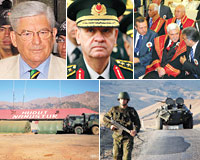
The Ergenekon case left an indelible mark on 2008, during which the military's influence over politics and the affairs of the deep state have been questioned. The first operation against the Ergenekon terror organization, which is accused of being involved in military coup plans to overthrow the ruling AK Party administration, was launched in early 2008.
During the process, which started with the seizure of army-made hand grenades in a slum house in İstanbul's Ümraniye district, leading figures -- including retired Gen. Veli Küçük, Workers' Party (İP) Chairman Doğu Perinçek, Cumhuriyet daily columnist İlhan Selçuk and former İstanbul University Rector Kemal Alemdaroğlu -- were arrested on charges of founding a terrorist organization and attempting to paralyze the government and Parliament. As the investigation probed deeper, intricate relations were revealed. Upon completion of the investigation process, 86 people were indicted and subsequent trial proceedings began at the İstanbul 13th High Criminal Court.
The case took on a whole new dimension when the Atatürkist Thought Association (ADD) chairman, retired Gen. Şener Eruygur -- who had attracted attention for his involvement in anti-government rallies ahead of the July 22, 2007 elections and had served as a gendarmerie commander during the alleged military coup attempts -- and retired Gen. Hurşit Tolon were also arrested in connection with the case. However, they said military coup plans were not involved in the proceedings because of the atmosphere created by army authorities, who paid an official visit to the two retired generals in jail on behalf of the Turkish Armed Forces (TSK). The trial process of the 86 defendants started on Oct. 20. In consideration of the insufficient space and technical equipment at the trial venue, the proceedings were taken to a special courtroom designated within the Silivri Prison complex. It appears that the trial will remain influential and attract greater attention in 2009.
Democracy under shadow of Constitutional Court
On March 14, Supreme Court of Appeals Chief Prosecutor Abdurrahman Yalçınkaya filed a closure case against the ruling AK Party, alleging that the party had become a center of activities violating the principle of secularism. In his indictment, the prosecutor asked for a political ban on 71 individuals, including the president and the prime minister. The case was concluded on July 30; six members of the court asked for the closure of the party whereas five members opposed this. The party survived the closure case because at least seven affirmative votes were needed for such an action. However, the court still decided that the AK Party should be deprived of half of the state aid it was entitled to in 2008.
The closure case received extensive attention from international actors including the EU, which reacted strongly against the whole process; the reluctance of the US administration to issue such a strong reaction was worth noting, however.
The subsequent decision by the Constitutional Court, which ruled for the annulment of the constitutional amendment lifting the headscarf ban at universities, showed how fragile the Turkish democracy was.
Parliament took action to amend the Constitution in an attempt to lift the longstanding ban on headscarves at Turkish universities when Nationalist Movement Party (MHP) leader Devlet Bahçeli expressed support for such a move in the aftermath of remarks Prime Minister Recep Tayyip Erdoğan had made on a trip to Spain. Erdoğan had said: "Imagine that they wear this as a political symbol; so what? Could you possibly see this as an offense?" The main opposition CHP took the constitutional amendments passed in Parliament by MHP and AK Party deputies to the Constitutional Court.
The court made an unusual ruling with respect to the amendments because it was not authorized to examine constitutional amendments with regard to substance. The democratic structure of Turkey has become controversial after the court's decision; discussions subsequently began with regard to the need for a restructured Constitutional Court.
Terror escalates in 2008
In 2008 Turkey took effective steps against the outlawed Kurdistan Workers' Party (PKK) terror organization, which had killed 12 Turkish soldiers in an assault in Hakkari on Oct. 21, 2007. The TSK, which was unable to stage a comprehensive land operation in northern Iraq because of an ongoing disagreement with the US since 2003, bombed PKK camps in an aerial incursion in December 2007.
On Feb. 21, 2008, a comprehensive land operation was initiated against PKK militants; during the operation, which lasted through Feb. 29, 240 terrorists and 27 Turkish soldiers were killed.
Turkey's combat against terror continued throughout 2008 while some debates have also been voiced. Intelligence weakness was at the top of these debates because of the loss of 17 soldiers in a PKK raid against an outpost in Aktütün on Oct. 3. A bitter polemic erupted between the Taraf daily, which published allegations of intelligence shortages, and Chief of General Staff Gen. İlker Başbuğ; in consideration of the growing dissent and controversy, the government called for an extraordinary meeting of the Higher Counterterrorism Board (TMYK) where parties decided to assign the Interior Ministry the task of coordinating counterterrorism activities. For the first time in republican history, a civilian initiative was authorized to deal with terror. However, legal amendments for such an authorization are still pending; it is expected that relevant legislations on this matter will be promulgated in 2009.
Amid discussions on how to deal with terror, PKK terror killed 18 people in two consecutive explosions in the Güngören district of İstanbul. The terror organization also killed seven in Diyarbakır in an attempt to take revenge for the cross-border operations. In an armed assault in front of the US Consulate General building in İstanbul, three police officers were killed by three terrorists, who were also killed on site.
3 parties change their leaders
Deniz Baykal was re-elected CHP chairman at the party's 32nd Grand Convention. Numan Kurtulmuş, Salih Uzun and Süleyman Soylu became the new chairmen of the Felicity Party (SP), Motherland Party (ANAVATAN) and Democrat Party (DP), respectively. Nurettin Demirtaş, who was arrested for submitting a falsified health report in an attempt to get away from military enlistment while serving as chairman of the Democratic Society Party (DTP), was re-enlisted following his trial. DTP Mardin deputy Ahmet Türk was elected in place of Demirtaş as the new chairman of the party.
Gen. İlker Başbuğ was assigned chief of general staff by the Supreme Military Council (YAŞ), which convened in early August. Gen. Işık Koşaner was appointed commander of land forces at the same meeting, where Avni Atilla Işık became the new commander of the gendarmerie. The lack of any discharge from the military at the council meeting led to political debates.
The Deniz Feneri e.V case in Germany also sparked serious controversy in Turkey because of its connection with leading Turkish political actors. The case has turned into a matter of political rivalry between the ruling AK Party and the main opposition CHP because of the involvement of Radio and Television Supreme Council (RTÜK) Chairman Zahid Akman, who was appointed by the AK Party, in the case.
2008 also saw the death of several leading Turkish political figures. These included MHP İstanbul deputy Gündüz Aktan, AK Party İstanbul deputy Osman Yağmurdereli and former ministers Ayvaz Gökdemir and Ersin Faralyalı as well as former Social Democracy Party (SODEP) leader Cezmi Karatay.


