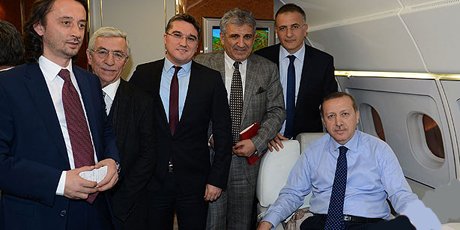
The Turkish prime minister has said Turkey has already spent more than $600 million in taking care of Syrian refugees that have taken shelter in the country, vowing that Ankara's “open-door” policy will continue.
Recep Tayyip Erdoğan, speaking to a group of journalists on a plane en route to Ankara from Bratislava, also said aid to the Syrian opposition is increasingly growing and wealthy Gulf nations are taking the lead in assisting the opposition.
Donor countries pledged more than $1.5 billion to aid Syrians stricken by civil war last month in Doha. About $1 billion is earmarked for Syria's neighbors hosting refugees and $500 million for humanitarian aid to Syrians displaced inside the country.
The $500 million would be channeled through UN partner agencies in Syria and the entire aid pledge would cover the next six months.
The oil-rich Gulf Arab states of Kuwait, Saudi Arabia and the United Arab Emirates each promised $300 million at the meeting. Its 60 participants included Lebanon, Jordan, Iran, Tunisia, the United States, Canada, Russia, China, Japan, South Korea, Turkey and a number of European countries.
Four million Syrians inside the country need food, shelter and other aid in the midst of a freezing winter, and more than 700,000 more are estimated to have fled to countries nearby.
Erdoğan said his country has led diplomatic efforts to find a solution to the 22-month crisis in Syria in rounds of diplomacy with international organizations such as the UN, Organization for the Islamic Cooperation (OIC) and countries including China and Russia.
More than 60,000 people have been killed in all, according to a UN estimate, since the conflict began as a peaceful movement for democratic reform and escalated into an armed rebellion after President Bashar al-Assad tried to crush the unrest by force.
Diplomacy to halt the war has been stymied by deadlock in the UN Security Council between Western powers, who want Assad to quit as part of a democratic transition, and Russia, a close Assad ally that rejects outside interference in Syria.
Erdoğan reiterated his position on the future of Assad and said Syria's embattled president is bound to leave. “He is not there to stay,” Erdoğan stressed. He said Syria's opposition fighters are doing everything in their power to unseat the regime and that the contribution and aid they receive after the Doha meeting will increasingly grow.
The Turkish prime minister noted that his country's humanitarian aid to Syria is under way and that Ankara's “open-door” policy will continue unhindered.
Also speaking about calls by Syrian opposition leader Mouaz al-Khatib for the Syrian regime to hold dialogue to end the violence, Erdoğan said the opposition leader's remarks were misinterpreted. He added that al-Khatib wanted to say that the opposition would hold talks with the Syrian regime without including Assad. He categorically rejected the claim that al-Khatib accepts the idea of talking to Assad.
He said al-Khatib's invitation to the Syrian regime is part of a peace process put forward after Geneva meeting last year.
After 22 months and more than 60,000 dead, Syria's crisis appears to have reached a stalemate, with neither side making significant battlefield gains likely to bring about a military victory any time soon.
The US and other world powers have pushed for a negotiated solution -- a bid which appeared to get a boost this week when the head of the opposition's National Alliance said he would be willing to negotiate with certain figures from the Assad regime "who don't have blood on their hands."
Khatib first suggested the possibility of dialogue last week in a post on his Facebook page, sparking a wave of criticism from activists and members of his own group who say the regime has killed too many people to play a role in the conflict's solution. Many accused Khatib of acting unilaterally, and he clarified in a subsequent post that he was expressing his personal views.
He explained his position further on Monday, preconditioning the talks on Assad's departure and saying they could spare Syrians more suffering.
He also suggested that there are regime officials the opposition would agree to meet with, mentioning by name one of Syria's two vice presidents, Farouk al-Sharaa. In December, al-Sharaa was quoted as acknowledging that the army could not defeat the rebels and calling for a negotiated settlement.
Speaking about the presence of Kurdish militants linked to the terrorist Kurdistan Workers' Party (PKK) on the Turkish border in Syria, Erdoğan noted that the group, known as the Kurdish Democratic Union Party (PYD), is having a difficult time. He added that the opposition forces have started to marginalize its presence.
Erdoğan was referring to weeks of fighting between Syria's opposition fighters and the PYD in Ras al-Ain and other border towns that left dozens of people killed, further weakening the presence of the PYD in the region.
Turkey says Syrian refugee spending exceeds $600 mln
The Turkish prime minister has said Turkey has already spent more than $600 million in taking care of Syrian refugees that have taken shelter in the country, vowing that Ankara's “open-door” policy will continue.