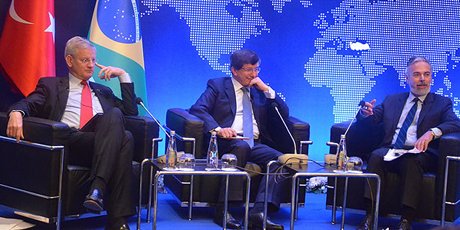
The foreign ministers of Turkey, Brazil and Sweden, who addressed Turkish ambassadors from around the world in İzmir on Saturday at the Fifth Annual Ambassadors' Conference, underlined the importance of facing the challenges of a changing world together as they announced a new trilateral initiative.
The new initiative's name is inspired by the initials of three countries as announced by Turkish Foreign Minister Ahmet Davutoğlu: Trilateral Solidarity for Building Peace.
Davutoğlu said there were similar approaches in the foreign policy-making of the three countries. “It is a decision to develop a common perspective to regional and global issues,” said Davutoğlu as he pointed to the cooperation between Turkey and Brazil in the nuclear issue regarding Iran.
Carl Bildt, the foreign minister of Sweden, said the unity of Syria is as important as that of Cyprus, Lebanon, Iraq and Azerbaijan, while praising the Turkish government and people's generosity in “averting a catastrophe in Syria.” The minister stated the EU's eagerness to work with Turkey in these challenges although he added, “What lies ahead might be more difficult,” in reference to the crisis of the Middle East region. He also noted that Sweden had hosted the largest Syrian community in Europe even before the crisis.
Allocating most of his address to a comparison of Europe's current economic crisis to the previous economic failures of the 20th century, Bildt said that unlike some predictions, Europe did not fail and it will not fail. According to Bildt, “The lesson of the past is that only by working together can we move forward in Europe.” However, he noted that in 2014 the world will dominate Europe while in 1940 it was the Europe that dominated the world. With cautious optimism, Bildt provided the example of Sweden, which was able to emerge from turbulent economic times in the past in an effort to prove the reasons for this optimism.
The foreign minister of Brazil, Antonio Patriota, emphasized the developing bilateral relations between Turkey and Brazil and defined the relations as strategic. He also said, “The Israel and Palestine issue is an area in which both countries can help to create new momentum.” The minister, however, did note that neither of the two countries are members of the United Nations Security Council. As far as the Arab-Israeli conflict resolution efforts are concerned, Patriota called the Quartet [an international entity mediating the peace process between Israel and Palestine composed of the United States, the United Nations, the European Union and Russia] dysfunctional.
Patriota said that unlike Brazil, a country that is surrounded by democracies, Turkey faces challenges of chemical and nuclear weapons in its region. Another difference he cited between his country and Turkey is the energy issue. “Soon Brazil will evolve into an oil exporting country,” Patriota said while he listed energy as one of the vulnerabilities of Turkey.
Emphasizing that both countries can act on common values despite differences, Patriota also added that Brazil might consider becoming an observer in the Organization of Islamic Cooperation (OIC).
Turkey, Sweden, Brazil form Trilateral Solidarity for Building Peace
The foreign ministers of Turkey, Brazil and Sweden, who addressed Turkish ambassadors from around the world in İzmir on Saturday at the Fifth Annual Ambassadors' Conference, underlined the importance of facing the challenges of a changing world together as they announced a new trilateral initiative.