

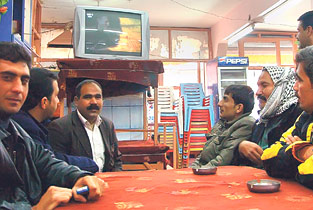
The ban was lifted in 1991. The Turkish Radio and Television Corporation (TRT) will dedicate one of its five channels to full-time broadcasts in Kurdish and other languages. Broadcasting in Kurdish will commence on Jan. 1, 2009. Turkey first aired programs in Kurdish, Arabic, Bosnian and Circassian in 2004, allocating two hours per week for each language, but this scheme proved to be insufficient.
Speaking with Today's Zaman, TRT General Manager İbrahim Şahin said the reason for the protracted period of preparation has been a lack of personnel who speak Kurdish.
TRT will assign a channel to full-time broadcasting in Kurdish, with preparations almost complete. The station will later add Arabic and Persian to its list of broadcasting languages and is expected to begin broadcasting in these languages some time next year, he added
Tarık Ziya Ekinci, a prominent Kurdish intellectual, suggested that broadcasting in Kurdish will significantly contribute to the establishment of social peace in Turkey. " This is a very important step, and I believe it will help stop bloodshed and silence guns," he said.
Parliament passed a bill on May 29, 2008, allowing TRT to broadcast programs in Kurdish. The ruling Justice and Development Party (AK Party) and the pro-Kurdish Democratic Society Party (DTP) supported the bill, while the Nationalist Movement Party (MHP) opposed it.
DTP finds efforts insufficient
Although it supported the bill allowing broadcasting in Kurdish, the DTP is now skeptical about the move. DTP Co-chairwoman Emine Ayna claims TRT's broadcasting in Kurdish is " unconstitutional."
" Intentions are more important than broadcasts. What are the intentions behind this move? We don't think broadcasting alone will be sufficient. Moreover, if your intention is to only broadcast, this will be against the Constitution. If the broadcasts are made in order to strengthen fundamental rights and freedoms, then constitutional guarantees should be provided for this. Otherwise, these broadcasts will be unconstitutional. Turkey should amend the Constitution," she told Today's Zaman.
Kurdish intellectuals offer full support
Şerafettin Elçi, the leader of the pro-Kurdish Participatory Democracy Party (KADEP), indicated that this move will make Kurdish citizens believe the state places importance on them. " Until now, the official policy has been the denial of the existence of a Kurdish language. This meant rejection and denial of Kurds. It is important in terms of official acceptance of the Kurdish language," he said.
Abdülmelik Fırat, the former chairman of the pro-Kurdish Rights and Freedoms Party (HAK-PAR), too, believes that TRT's allocating one of its channels to broadcasts in Kurdish will prove beneficial for social unity. However, he said, the bill should be well designed so as not to give bureaucrats room to maneuver. " It is a gigantic step for TRT to broadcast in Kurdish all day long. I would like to congratulate TRT for this good move and determination. It is nice to see the offense inserted in the Constitution as a result of military rule following Sept. 12, 1980 [a ban on the use of Kurdish] overturned. I regard it as an important step that will cement the country's unity," he said.
Programs mostly with subtitles
TRT will have to use subtitles in its Kurdish programming because dialects of Kurdish spoken in Turkey vary considerably. These subtitles are expected to help standardize Kurdish in the long run.
Ömer Büyüktimur, president of Söz TV, a Diyarbakır-based private TV network airing Kurdish programs, previous told Today's Zaman that his station has experienced problems in broadcasting Kurdish programs due to the differences in dialect and vocabulary.


