

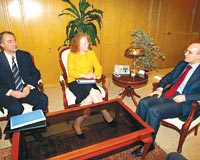
Prime Minister Recep Tayyip Erdoğan sparked controversy over the IMF in October when he accused the organization of seeking to "squeeze Turkey's throat" by curbing needed spending programs. "We will not cast our tomorrows into darkness by bowing to IMF demands in such a time of crisis," he said then. Against this background, talks over the new agreement have begun. New IMF Turkey desk chief Rachel van Elkan leads the IMF delegation to negotiate with Turkey and met with State Minister Mehmet Şimşek on Thursday. The difference between these meetings and those of the past is that the government is pushing its own agenda this time.
Ruling Justice and Development Party (AK Party) parliamentary group deputy chairman Nurettin Canikli said that the signature of an imposed agreement as in times past was out of the question. "For the first time in its history, Turkey is making the IMF accept [Turkey's] own conditions," he said. Opposition deputies and economists Esfender Korkmaz and Mithat Melen, however, claim that the government is just making a panicky attempt to appear strong in the public eye.
As part of the pressure for "making an agreement with the IMF" that the executives of holding companies and businessmen's organizations have been exerting along with the opposition parties, they accused the administration of taking action too late, driving up the price to pay. Canikli says the pressure decreased during the most recent period and that the government's determined stances were effective in easing the pressure. Canikli said they had managed the biggest economic crisis of the century without the IMF. "We have proved this. However you look at it -- in technical terms, in monetary terms, in terms of international credibility -- without the IMF's support, we are managing this crisis, the biggest one of the century," he said. "Despite the lack of the IMF, our banks are standing and our finance sector has not seen harm."
Akbank executive board president Suzan Sabancı Dinçer wants the crisis period to be productive and says Turkey will close 2009 on a positive note. Speaking about Turkey-IMF relations, she said: "An agreement with the IMF is important, but what is more important is to agree with good conditions. The effect of this agreement may not be seen immediately. Turkey will be the first center of attention at the exit of the crisis. I believe it is necessary to be productive during this period."
Still, Republican People's Party (CHP) İstanbul deputy Korkmaz says the chances of standing up to the IMF for long are slim to none. "When the final decision rests with the IMF, the country sitting at the table with them is limited in its ability to speak. The country might or might not accept the IMF's conditions, or it might be able to coax some strategic compromises from the IMF. But getting a compromise out of the IMF is difficult," he said. For his part, Nationalist Movement Party (MHP) İstanbul deputy Melen accuses the government of wanting to delay the signing of the IMF agreement until after the local elections in March.
All parties agree IMF double standard needs to end
While the three representatives of the ruling party and two opposition parties defend different ideas with respect to Turkey's insistence on its own stand-by agreement conditions, they all agree that the IMF needs to renew itself. The AK Party's Canikli says the IMF has a double standard when it comes to dealings and policies with developed and developing countries, and the CHP's Korkmaz and Melen of the MHP say that this mistake needs to be brought to an end.
The IMF's current structure and template agreement packages do not exhibit a very efficient performance, Canikli says. "There are a number of things about itself that the IMF needs to examine. Firstly, it needs to review its management style," he said. "Secondly, it needs to examine the template recommendations that it has implemented to date [tight budget-tight monetary policies]. It needs to create policies that are flexible and can change from country to country. And there's something else that's necessary -- for it to distance itself from double standards. That is to say, in the period in which we're living, the IMF needs to save itself from the double standard of recommending to developing countries the same old classic template recommendations while it urges expansionary Keynesian policies for developed countries that boost public spending."
Instead, Canikli recommended, the IMF needs a more objective structure, and for this to develop, the organization's voting rights need to be adjusted. The AK Party deputy maintains that the weight of votes held by developing countries needs to be changed so that the IMF can possess a structure capable of guarding the world financial system.
The CHP's Korkmaz said it is an obvious double standard when the IMF recommended that Turkey cut investments as it recommended America raise consumption spending. "The IMF's prescriptions for Turkey in this period are prescriptions that will pave the way for recession and a deepening of the crisis for the Turkish economy," he says. The IMF's biggest mistake was recommending the same policies for periods of recession as it did in periods of economic expansion, Korkmaz added.
The MHP's Melen declared that the world's current economic problems far exceeded the IMF's mission and that since the IMF has not renewed itself, the world now needs new organizations. "It's become clear that the IMF is not going to find a solution to the world's current problems," he said. "And the IMF is also aware of this."
Countries' problems are growing so fast that they are exceeding the IMF's authority, duties and mission. "So the IMF must be reorganized, or else there will be a need for new organizations like a World Central Bank to meet the world's new economic cycles," Melen warned.
Opposition not quite helpful
Canikli, the deputy chairman of the AK Party's parliamentary group, said the opposition's attitude on the issue was problematic. Recalling that Turkey's last accord with the IMF expired in May of last year, Canikli stated, "We have been managing the greatest global crisis of the century that emerged in this period on our own, with the IMF's support."
Asserting that the opposition's stance regarding the IMF is contradictory, Canikli added: "Really, we are living through an era from which we can draw historical lessons. Main opposition leader [Deniz] Baykal first said we were running late. He said, 'You will pay the price for being late.' Not only the opposition, but all the media said the same thing. However, we are not borrowing from the IMF, as they have in the past, because we are in dire straits in terms of balance of payments. This has been done too many times in the past. Look, last May, our agreement was over, and we have been going on without the IMF since then despite the biggest crisis of the century."
Reiterating that previous governments had to apply rules dictated by the IMF, out of having no options to pay back the loans borrowed, Canikli stated: "We are not in that situation. We certainly do not need money at this point. We haven't spent or wasted central bank reserves. We have $70 billion in reserves. We are completely self-sufficient technically as well. I mean this in terms of governance and IMF recommendations. We are self-sufficient; we don't have any problems. But some circles have persisted in forcing a psychological atmosphere on us so that we felt the need to sign the 20th agreement to make use of the IMF's credibility and to dissolve the psychological atmosphere in public opinion."
Canikli said the 20th stand-by agreement was radically different from previous accords with the IMF in that now it was the IMF accepting Turkey's terms, and not the other way around. "Turkey is not a country that is being dictated to now; it has become the country that resists. We decide our own terms now. We do not accept any of the IMF recommendations that include contraction or cutting public spending. We have targets, and the IMF has now agreed with what we say. We have set our own terms. Turkey is a country now that has negotiating power and that can resist the IMF's terms."
'An agreement of the IMF's design will not do'
AK Party parliamentary group deputy chairman Canikli says the agreement does not necessarily have to be signed in January. "If the IMF tells us, 'Raise your interest rates,' this agreement won't happen. Or if they say, 'Lower your spending even more,' this agreement isn't going to happen," he said. "I'm saying it quite explicitly; this sort of thing will not happen. We don't need [an agreement] of that sort. Or if they say, 'Pursue a policy that will pave the way for your exchanges to fall again,' this sort of thing will not happen."
Canikli said that his party's opposition to an IMF-engineered stand-by agreement was not a bluff. "The IMF really gives cheap loans. We don't have any urgent need, but let it remain off to a side so that we can use it if and when time necessitates our doing so," he said. "But it's impossible for us to accept and sign an agreement within the context of the classic template and conditions. We're expressing this very clearly; this isn't a bluff opposition. Because the real truths are as they are, we do not accept this."


