

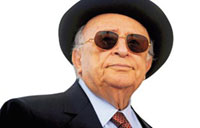
Demirel said in an interview with Eko Enerji magazine that there is only one state in Turkey, adding that its oneness is vital for the country. " But when the country is dragged to the brink of the abyss or civil war, then the military stages a military coup. Turkey has experienced this a few times," Demirel said. " If you want to define this situation, you can say that the military is the state. It is deep in the state. In other words, it is the deep state." Demirel said it is dangerous for the military to be involved in politics.
"The military is divided when engaged in politics. We are afraid that a military that stages a coup and is engaged in politics will be divided into camps within itself. This is what we politicians are afraid of. Therefore, the military should abandon politics and return to its primary duty," Demirel said.
He also expressed discontent over the detention and arrest of former and active duty army members as part of the ongoing investigation into the Ergenekon gang, charged with plotting a coup. "These detentions and arrests have disturbed society. But on the other hand, if there are weapons around and there is preparation for a coup, you cannot tell anyone not to touch these people," he said. "However, it hurts when you implicate people in such affairs on suspicion that they may be part of such a plan."
'No. 1 is an active duty general'
 Tuncay Güney, a suspected former Ergenekon member, claimed that the clandestine group's leader was a general on active duty. |
In the meantime, Tuncay Güney, a suspected former member of a clandestine terrorist organization known as Ergenekon, claimed on Sunday that the shadowy group's No. 1 is an active duty general in the army and that the leader's consultant is a retired general, according to the Bugün daily.
Güney, a curious figure with significant information and knowledge of details of crimes allegedly perpetrated by Ergenekon, a clandestine terrorist organization with branches within the state structure, spoke to the Toronto-based Turkish newspaper Canada Turk on Sunday and claimed that Ergenekon's top man is an active duty general. "His consultant is a retired general. The head of the group's civilian wing is a media boss," he asserted.
Güney, who lives in Canada and serves as a rabbi at a Toronto synagogue, was captured in 2001 in an earlier investigation into Ergenekon. The current indictment relies heavily on Güney's police testimony. Güney, who also worked for the National Intelligence Organization (MİT) at some point, though MİT denies he was an agent on permanent contract, has on numerous occasions spoken to Turkish television stations via a satellite link from his Canada home. He has provided detailed information about Ergenekon crimes and members, producing more questions than answers; however, his status in the case and why he has not been called to testify was not clear.
Güney also claimed one of the torture centers of JİTEM, an illegal gendarmerie unit, was based in northern Iraq. He recently said a large number of people in Turkey's Kurdish-populated Southeast were executed by JİTEM in the 1990s and that their bodies were buried in wells located near facilities of the state-owned Turkish Pipeline Corporation (BOTAŞ) in Silopi after they were doused with acid. Güney, however, contradicted his previous remarks on the issue when he told Canada Turk that such wells do not exist.
"The General Staff demanded that I misrepresent the existence of these wells. They shouldn't look for acid wells in Turkey in vain. The bodies were not buried in acid wells. There were acid barrels into which the people to be killed were thrown. It is not possible to find even the bones of these people. Acid barrels were brought to Turkey by [Ergenekon suspect] Sami Hoştan, a drug dealer," Güney said.
He also said he was surprised that the existence of Encümen-i Daniş (Consultation Council) was revealed. Considered to be a "think tank" that included some of the most powerful figures in the country who came together on a regular basis behind closed doors to talk about Turkey's problems, the council worked to influence decision-makers in the country ahead of the Feb. 28, 1997 post-modern coup, several Turkish newspapers reported last month.
"There is another group known as the Milli Birlik Komitesi [National Union Committee] above Encümen-i Daniş. And below it are Masonic lobbies," Güney noted. He also claimed a Turkish-Jewish businessman was murdered in 2001 because he allegedly betrayed the cause of his Masonic lobby.
Güney also commented on the ties between the main opposition Republican People's Party (CHP) and the Ergenekon gang. "If you examine the ties of [CHP deputy secretary-general] Mehmet Sevigen and former Prime Minister Mesut Yılmaz, you will see who is trying to cover up the Ergenekon investigation. There is a great amount of interaction between Ergenekon and the CHP," he said.
Güney also stated he will not make a deposition on the Ergenekon case in Turkey. "I don't know whether I am a witness or a suspect in the case," he said. "If I am a suspect, I will not speak about it. I will not give a deposition on the case if I don't want to. I received death threats, but I am well protected."


