

According to the latest figures, the country's gross domestic product (GDP) growth slowed to a 0.5 percent crawl in the third quarter of 2008 compared to the same period in 2007. Unemployment had risen to 10.3 percent as of September compared to the same month last year, when it was around 9.3 percent. All in all, discouraging economic growth rates and skyrocketing unemployment figures throw further doubt on government declarations that Turkey will survive the ongoing turbulence with " very few" losses.
Also, the total amount of Turkish manufacturing capacity utilized in November fell by a record 9.7 percent compared to the same month last year, according to recently released figures, with just 72.9 percent of the country's total industrial capacity now being used. Some of the leading representatives of the Turkish business world yesterday called on the government to take urgent action, asserting that alarm bells were ringing for the Turkish economy.
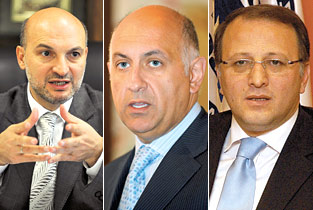
Independent Industrialists and Businessmen's Association (MÜSİAD) President Ömer Cihad Vardan said they could not see the latest growth figures, representing a total increase of just 3 percent for the first nine months of 2008, as satisfactory. " It is now really hard to say that we are pleased with the current developments, especially because this growth rate is so frustrating," he stressed, adding that Turkish society had gotten used to seeing much higher growth rates in the last few years. He said the government should take action and focus on effective solutions. " The most important thing that the government should focus on is increasing growth and employment, as well as supporting the non-financial sector, particularly the small and medium-sized enterprises [SMEs]," he noted, emphasizing that this will help maintain stability in the domestic market. He also said it was of the utmost importance that the government not diverge from its public investments. " We need activity, not inaction. The government has to force the issue despite all negative occurrences and implement new projects courageously," he underlined. " Our priority during the crisis should be reviving the domestic market; only then we can feel safe and sound," he added.
Regarding talks between the government and the International Monetary Fund (IMF), Vardan said they did not feel that Turkey was by any means obliged to sign a standby deal with the institution. " We have learned from our experiences that the IMF was not helpful in solving Turkey's problems," he explained, underlining that, except for the last standby deal, which expired in May this year, the other 18 agreements with the IMF in the past had been nothing but " failures."
Turkish Industrialists and Businessmen's Association (TÜSİAD) board member Ali Kibar said the Turkish economy was facing serious stagnation and even the possibility of recession. Speaking at a conference yesterday, Kibar said the Turkish economy was facing serious risks from the current global financial turmoil, no matter how strong the country's economic structure may be.
He stressed that the recent figures indicating a 0.5 percent growth rate in the third quarter of this year showed that the Turkish economy was now deeply affected by the negative affects of the global storm. " It will not be a surprise if these negative figures continue in the coming months," he said, underlining that there would be a risk of recession in the new year. However, he stressed that the growth rate could still be regarded as a positive development, because many countries are in far worse positions than Turkey.
Kibar said increasing unemployment, declining domestic economic activities and decreasing private sector investments all posed a major threat to the country. Stressing the risk of social unrest and political uncertainty, he noted that the government needed to take the necessary precautions as soon as possible to disperse the gloomy atmosphere before it led to chaos. " The government should show determination and take action," he added. He also said some precautions taken by the Central Bank of Turkey recently had been helpful in easing the problems of the market to some extent.
Turkish Union of Chambers and Commodity Exchanges (TOBB) Vice President and Gaziantep Chamber of Industry (GSO) Chairman Nejat Koçer said the recent developments were signs of danger for the economy and that the government needed to implement a new, effective fiscal policy. He underlined that the 0.5 percent growth rate was the smallest seen in the last 27 quarters and that more people are joining the ranks of the unemployed in Turkey. He said they had been trying to attract attention to the negative developments since last year and that, had the government listened to them, things would be better now. " Now all the indices support our idea. It is high time to act swiftly, taking the developments seriously. The government should create new initiatives immediately," he stressed.
Koçer said the government should focus on increasing production and exports. He underlined that it was of the utmost importance to maintain morale and confidence in the domestic market, adding that markets would need a long time to shake off the negative effects of the crisis. " All sectors should support one another," he emphasized, noting that the banking sector should not hesitate when extending loans to companies. He also noted that Turkey's imports were expected to decline by $50 billion in 2009 and that this would be to the benefit of Turkish producers. " The demand in the domestic market will then be met by the local producers and this will help boost production and increase employment," he added.
MÜSİAD's suggestions for government measures to ease effects of crisis
1. The government should focus on taking new steps to encourage investments in the country. The value-added tax (KDV) for investment expenditures can be reduced to 1 percent.
2. Energy prices can be lowered and this will help decrease the burden on producers, increasing morale in the domestic market.
3. The automotive sector, which has been badly hit by the crisis, needs support. The government can reduce the private consumption tax (ÖTV) for this sector.
4. The government can provide unemployment financial assistance for longer terms.
5. Trade, industry and export unions should give financial support to their members by using their own resources. This will help activate the economy .
6. The Small and Medium Industry Development Organization (KOSGEB) and Türk Eximbank should increase their financial support to small Turkish companies and exporters.
7. The government should lead and encourage the Turkish exporters to enter new export markets.
8. The government can extend the terms for the payment of social security premiums to help employers.
ERGİN HAVA İSTANBUL


