

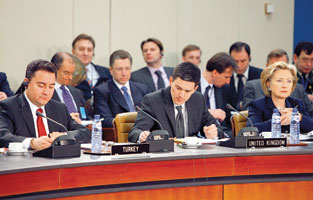
Babacan, speaking ahead of a meeting of NATO foreign ministers in Brussels, also called on the West to scrap policies that would be deemed threatening by Russia.
" First we have to make clear who this project is aimed at. Who is the threat in mind when this system is built?" Babacan remarked when asked to comment on the Turkish stance on US plans to install missile defense shield system components in NATO allies Poland and the Czech Republic. " If the target was really Iran, we would not have had the problems we have today between Russia and the United States. ... It means there are other aspects to the matter."
The Russians are angry about the plan, drafted by the Bush administration but now under review by the Obama administration. It calls for missile interceptors in Poland and missile-tracking radar in the Czech Republic, a scheme that Moscow says is aimed at containing Russia. US Secretary of State Hillary Clinton, also attending the NATO meeting, said in Wednesday remarks that the Russians should understand the missile shield is not aimed at them, without saying whether President Barack Obama would proceed with the plan. " I think they are beginning to really believe it -- that this is not about Russia," she said.
Although Turkey and Russia have traditionally had conflicting interests in the southern Caucasus, they have taken steps in recent years to boost cooperation, particularly in the field of energy and trade. Russia now stands as Turkey's biggest trade partner, with most of the trade being in the form of Turkish purchases of Russian natural gas.
Babacan said weapon systems built as deterring factors were more than necessary and called for a new understanding of disarmament. " Whenever there is tension in ties with Russia, both sides of the tension lose. We believe threatening or being threatened should not be an element of relations. Every country may have security concerns, but they all must be resolved through discussion," Babacan said.
Relations between Russia and NATO deteriorated significantly in 2008 when the 26-nation alliance decided to freeze its ties with Moscow over its invasion of Georgia due to a dispute over the breakaway province of South Ossetia.
Babacan's remarks came as NATO moved to restore its ties with Russia. The alliance was expected to decide at the end of yesterday's one-day meeting that it was time to resume ties, seven months after they were suspended.
Clinton said in her speech at the gathering that it was time for NATO to make a new start with Russia, but urged the alliance to leave open the door to membership for ex-Soviet states Ukraine and Georgia, which Moscow opposes. " It's time to explore a fresh start. We can and must find ways to work constructively with Russia where we share areas of common interest, including helping the people of Afghanistan," she said.
Babacan said 2008 was not a good period in Russia-NATO ties because of the war in Georgia and emphasized that " policies that make Russia feel besieged are wrong."


