

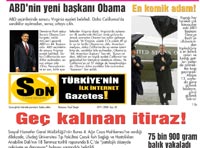
In the face of the global financial turbulence, several Turkish newspapers have geared up to withstand its negative impacts on the media sector. They have gone into massive cost cutting, including the dismissal of hundreds of journalists. However, there is little hope that the measures will be sufficient. Turkish media outlets feel pressured to introduce new measures to avoid a fate similar to that of popular US dailies.
In the latest sign that the crisis has hit once flourishing US media, the Tribune Company -- the publisher of two of the most popular US dailies, the Los Angeles Times and the Chicago Tribune -- recently announced that it has filed for bankruptcy. The company is said to have nearly $13 billion in debt compared to $7.6 billion in assets. The New York Times is seeking a $225 million loan against its headquarters in midtown Manhattan. The popular Miami Herald has been put up for sale by its owner. And stocks of CBS, one of the most popular broadcast networks, have fallen below $5 in recent weeks.
Turkish print media dropped the first signals of being struck by the global financial crisis as early as October, when some newspapers' staffs were advised by their administrators to cut down on their intra-company costs. Journalists and reporters working for the Çukurova Group's Akşam daily were told not to use workplace phones for personal conversations. Some administrators at the daily were asked to use their own means of transportation instead of being driven to the office in vehicles belonging to the daily.
Then came a decrease in the number of pages and supplements of newspapers. When this measure fell short of expectations to protect newspapers from the destructive effects of the financial crisis, they resorted to laying off some of their columnists. Among these were Pakize Suda from Hürriyet, Güler Kazmacı from Posta and Tuba Akyol from Milliyet.
As another step to fight the economic turmoil without dismissing any workers, the Cumhuriyet daily chose to increase its price to YTL 1 from YTL 0.75 for the weekend editions.
Another Turkish newspaper going through hard times is the Taraf daily, which has uncovered many outstanding stories since it began publishing last year with the aim of making Turkey a more democratic country. "We are passing through difficult times," was the headline of a statement on the daily's Web site, which said the newspaper's advertisement income was lower than ever and called on its readers to buy advertisements on its pages so that it could find a way out of the financial crisis without being obliged to lay off workers. The campaign was met with enthusiasm by readers, who lent financial support to the daily through small ads published in their names. The daily, which has drawn the ire of the Turkish military and the government, does not receive ads from big companies needed to meet its expenses because the companies are afraid of confrontations with the military and the government.
Drop in advertising and mass layoffs
Turkish newspapers have suffered from a gradual drop in revenue since the first half of 2008, largely stemming from the rapid disappearance of advertising. As large companies feeling the heat of the financial crisis, which led to a drop in their advertising budgets, newspapers have undergone difficult times and have searched for ways to overcome the crisis with the least damage possible. Among these ways is one that is desired by few: layoffs.
The Çukurova Group has dismissed more than 400 workers in the last few months, justifying the layoffs by noting that it is almost impossible to resist the impact of the global crisis. Mass dismissals sparked protests by journalists belonging to various media groups. Journalists organized a large rally in early December in İstanbul to condemn the dismissals, saying workers are forced to bear the undesirable consequences of the crisis. "We will not say 'Thank God' to unemployment," "We will fight and win," "Ban layoffs" and "We want employment guarantees," read some banners carried by protesters.
Rüya Özkalkan from the Turkish Journalists Union (TGS) lashed out at media bosses for layoffs, saying they fired workers just to protect their profits. "Media bosses are so devilish and greedy that hundreds of journalists from Kanal D, CNN Türk, Star TV, the Hürriyet and Milliyet dailies, NTV, Kral TV, Sky Türk and Kanal 7 were dismissed in the last few months," she stated.
Many fear that layoffs will spread to other media outlets. There are rumors circulating that the Doğan Media Group and the Doğuş Group are preparing to dismiss workers as a measure to minimize the impact of the financial turmoil on their companies.
TGS President Ercan İpekçi warned media bosses not to see their workers as a means to reduce costs in times of economic crises. "Workers in the media sector observe once more how opportunistic their bosses are in times of economic crises. Media bosses see their workers, who have contributed to their companies for years, as a means to cut down on costs. Media workers refrain from being affiliated with a workers' union for fear of getting sacked. Their not being members of a union gives bosses a trump card to dismiss them whenever they wish. Workers in the media sector should unite under the roof of a workers' union," he stated.
Cutting back on home delivery as a solution
A newly announced measure by The Detroit News to curtail the growing impact of the crisis has inspired new discussion in Turkey over whether halting home delivery of newspapers for certain days of the week could be a cost-saving measure. While some say online editions may replace print newspapers, many others argue such a move could distract readers and urge them to no longer read newspapers.
The Detroit News -- owned by Denver-based MediaNews Group -- and another Detroit daily newspaper, the Detroit Free Press, recently announced that they would halt home delivery most days of the week as a cost-saving measure, instead offering readers an online edition. Starting in the spring, the Detroit Free Press will be delivered only on Thursdays, Fridays and Sundays, which are the days the papers carry the heaviest advertising loads. The Detroit News will be home delivered on Thursdays and Fridays as it does not publish on Sundays. Other days of the week, smaller print editions of the papers will be sold at stores, newsstands and coin boxes, and paid subscribers will have access to online facsimile "electronic editions" on non-delivery days.


