

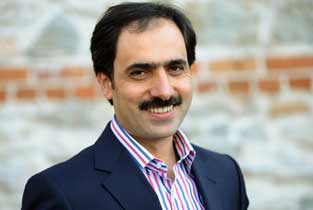
Speaking to Sunday's Zaman on the publication's 15th anniversary, Bülent Korucu, editor-in-chief of Aksiyon, vowed to maintain the magazine's leadership position among weeklies in Turkey. " With the circulation numbers approaching the 40,000 mark, a record for a weekly newsmagazine in Turkey, the magazine is shaping the debate today in Turkey, from politics to stem cell research," he said.
The total circulation of weekly newsmagazines in Turkey is not too high -- around 70,000, half of which is accounted for by Aksiyon. Korucu believes the ideal number for newsmagazine circulation in Turkey should be about 10 percent of total newspaper circulation, which corresponds to about 500,000. He blames the low circulation on poor marketing strategies adopted by magazines in the past. " Most magazines distributed promotional products like cleaning materials to boost sales or started to sell below cost to gain traction in circulation," he said. " Now the magazine industry is paying the price for its mistakes."
Korucu believes Aksiyon has not wavered in maintaining high standards in publishing from its inception and has shied away from provocative campaigns that have nothing to do with news making. " A steady climb in the number of subscribers is a testimony to Aksiyon's commitment to fair and balanced approach in reporting," he said. Nonetheless, the global crisis has taken a toll on circulation numbers. Coming out of summer vacation, the third and last quarters are usually a rebound period for magazines in Turkey. " We don't see that happening this year," Korucu noted.
Declining ad revenue and the increasing cost of paper and ink as a result of the weakening lira against foreign currency forced many magazines to reduce their number of pages. Aksiyon has dropped from 112 to 80; Newsweek Turkish weekly dropped from 112 to 70 pages.
Korucu took the helm at Aksiyon in July and started to implement slight changes in the magazine's page design. " I want to keep the editorial policy and business structure intact while adding small changes and improvements over time," he said. The first change came in the form of larger photos on news pages. Another was the introduction of a standard story format in the layout. " Do not expect anything too radical for the changes," he said, adding that " readers' habits do not change so easily."
" In terms of our readership profile, most of them are well educated," Korucu noted. " Forty-seven percent have bachelor's degrees, and 73 percent have a pro-EU stance." According to him, the most common characteristic of Aksiyon readers is not being content with regular news bits and broadcast feeds. " They want an in-depth look at stories with good background information," he said. " They also want to know what is going on behind closed doors."
Korucu said he did not feel threatened with the local launch of the Turkish version of Newsweek. " I welcomed their publication as I thought it would bring competition for better reporting and would raise the bar in the Turkish magazine industry," he said. In collaboration with Ciner Group in October, Newsweek started to publish a local version in Turkey, where the magazine industry is heavily dominated by sector-specific or entertainment-oriented media.

" Now we have competition, and this is healthy," Korucu said, hoping it would push circulation numbers upward. The latest data show Newsweek brought 15,000 new readers to the market, though publishers said they were expecting to hit 50,000 at the time of launch. " It's still too early to tell what will happen in the future," Korucu said, underlining that Newsweek took the plunge to 12,000 down from 19,000 after the first issue appeared on the newsstand. It bounced back to 15,299 in the first week of December, according to the latest data available from distributors.
A common understanding among magazine publishers in Turkey is that the market can sustain at most three newsmagazines. If that is true, Newsweek will either push Tempo or Aktüel from the cliff, provided that it retains more than 10,000 readers. " If not, we might see Newsweek exiting from the Turkish market," Korucu said, adding that it would be " very unfortunate." Today, Aksiyon leads the market with 34,130 subscribers, followed by Newsweek. Tempo comes third with 8,082 and Aktüel with 7,152 readers on a weekly basis.
Korucu led the Cihan news agency, which has the most subscribers among private news wire services in Turkey, before taking the helm at Aksiyon. " My experience in the wire industry taught me to make snap decisions all the time and act very fast, as you are in a race against time 24 hours a day, seven days a week," Korucu said. " I used to sell stories to professionals in newsrooms, so I know how they think. Now I can use all of my experience to make the weekly Aksiyon a much better magazine."
Aksiyon belongs to Feza Publishing Co., which also owns Zaman, a Turkish daily, and Today's Zaman, an English daily, both of which have the largest circulation in their categories in Turkey. Aksiyon was originally scheduled to launch in 1990, but the war in the Gulf forced company executives to postpone the launch. It finally got the green light on Dec. 10, 1994, in İstanbul.
" Our rivals thought we would be fly-bys in this business and stop publishing soon after we launched the paper," recalled Hasan Sutay, who was contracted to launch the weekly and served as a point man to get the project off the ground. The move was a risky one for a magazine industry that was accustomed to selling sensational and provocative material like the UK tabloid papers Mirror and Sun. " They thought the market was simply not ready for a serious newsmaker on a weekly basis. But they were wrong as we are celebrating our 15th year today," he said.

" We mostly focused on investigative journalism and in-depth news coverage and analysis," said Mehmet Yılmaz, who ran the weekly as editor-in-chief from November 2004 until July of this year. " The pressing issue for us was to find a quite different angle to the story that is already reported in print and broadcast media. I think Aksiyon has generated an expectation among its readers to have high-quality and well-versed stories."
Yılmaz described the magazine as " apolitical." " We dared to touch on many sensitive issues in Turkey, including the Kurdish issue, minority issues and freedom of speech and democratic reforms." In fact, issues dealing with the Kurdistan Workers' Party (PKK), a Marxist leaning terrorist organization, and Hizbullah, an extreme-right religious terrorist organization, prompted threats against the magazine.
" Our editorial and reporting reflected the transformation Turkey experienced, especially after the 2001 financial crisis," Yılmaz said. Many stories dealing with shadowy organizations and criminal networks that involve the military, the bureaucracy, the police and the justice system appeared in Aksiyon. The trial of Ergenekon, a clandestine network with links to behind-the-scenes intelligence units whose members are charged with plotting to overthrow the government, is a " testimony to our true reporting," Yılmaz said. " I remember some criticizing us for fishing for those stories. Now, with the Ergenekon case, we feel vindicated."
Apart from political issues, Aksiyon has also touched on a variety of hot-button social issues such as abortion, women preachers, stem cell research, nuclear energy, minorities and people with disabilities. Unlike many Turkish weeklies that focus mostly on urban life and celebrity news, Aksiyon at times ventures into the country's heartland and publishes stories that resonate with people residing outside of metropolitan areas.
The magazine unearthed a major financial scandal in the Turkish Naval Forces, which was forced to pay TL 13 trillion for decommissioned military vessels. It caused a public uproar at the time. The story, which appeared in May 1996, revealed the details of a secret military agreement between Turkey and Israel. For the first time in Turkey, Aksiyon published comments of former Gen. Şefik Soyuyüce, who admitted how the military junta used students to stir up havoc in Turkey to prepare for the 1960 military coup.

İbrahim Karayeğen, who worked as executive editor and later editor-in-chief for Aksiyon between 2002 and 2004, said working for the magazine is a completely different experience when compared with daily newspapers. " You can really focus on your story and study it from different angles, as you have more time," he said, adding that the " rush at the dailies to beat the deadline does not leave much room for extensive coverage."
Karayeğen witnessed the transformation years after the 2001 financial crisis, when fragmented political parties wreaked havoc in the governance of the country. " They were turbulent years," he recounted. " Everybody was expecting a new party, formed under the name of the Justice and Development Party [AK Party], to win," he said. " We just did not know it would be a landslide." Nonetheless, the magazine's editorial policy has not changed in those years. " We run the stories on an issue basis and have remained apolitical," he said. " After all, that is what our readers want."
Korucu, the current editor of the magazine, would like to attract more readers and hit the 100,000 circulation mark in the near future. " Turkey has a large, educated, young and dynamic population, and circulation should be much more than the current level," he said. He also plans to publish the magazine in languages other than Turkish. When asked if he is willing to enter joint publishing ventures with foreign partners, Korucu said, " We are ready to evaluate any proposal that may come along."


