

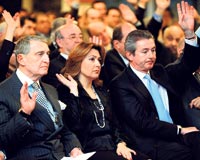
Speaking on Thursday at the inauguration of the TÜSİAD General Assembly, she said the government should determine the economic growth target for 2009. "We still discuss if growth in 2009 will be between -4 and 4 percent. Such a fact adds to the already bleak atmosphere in the markets. We need to break this 'vicious circle' as soon as possible so as to prevent things from growing worse," the TÜSİAD head noted.
"We urgently need to make a comprehensive analysis of the current state of the Turkish economy, and the government should follow policies in line with the outcomes of such a study," Yalçındağ said, stressing the need for a plan that would solve the urgent liquidity problem, create demand and prevent Turkey's competitive power from being harmed.
She said the Turkish business world must follow and understand the current developments in both global and domestic markets. "However, we are not yet sure how fierce the effects of the crisis will be on the Turkish economy. In addition to this, it is not certain whether the precautionary steps the government had taken in advance will prove successful in weathering the storm," she stressed.
The government should take steps so as to revive the economy, she said, noting that there are two basic points the government needs to focus on: maintaining healthy operation of the financial system and abolishing the obstacles preventing the Turkish nonfinancial sector from receiving loans and stimulating domestic demand. She went on to say that it was of the utmost importance to maintain lasting confidence in the domestic market.
Regarding relations with the European Union over the past three years, Yalçındağ said, "Both parties, Turkey and the EU, should get rid of the inertia and lack of confidence that prevail upon them." She said TÜSİAD welcomed Prime Minister Recep Tayyip Erdoğan's visit to Brussels. "The need Turkey and the EU have for each other became more apparent after the global economic and political crises in the world. Turkey should become a member of the EU in 2014 and enter the euro zone in 2018. The targets in question necessitate economic, political, judicial and social steps," she noted.
Speaking at the same event, TÜSİAD High Consultation Board (YİK) President Mustafa Koç said the government, which announced that Turkey's financial structure was sound, has failed to see the distress the nonfinancial sector was facing despite all indicators. Koç said the government's first reaction to the financial crisis was denying its existence. "Instead of creating a strong package of measures, the government chose to take individual and disordered precautions and has postponed an agreement with the International Monetary Fund [IMF] as long as it can," said Koç.
He pointed out that while the consumer confidence index hit its lowest levels, unemployment rates peaked. "Because production is dropping, the current account deficit may relatively decline, but its financing will be harder compared to the past. Additionally, the private sector's debts in foreign currencies are at a high level," said Koç. He added that unlike the 2001 financial crisis, it would not be possible to compensate for the contraction in the domestic market through exports, as there has been parallel contraction in all global markets.


