

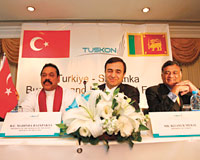
Taking the podium at the event, Bogollagama declared that there was " lots of room for improvement" in fostering trade between the two countries and focused on the opportunities that Sri Lanka presented for Turkish business, stemming in large part from the country's position as a " bridge" between the Middle East and the Far East -- both of which are an approximately equal distance from Sri Lanka by plane.
Stressing that greenfield foreign direct investment (FDI) to the country was $285 million in 2005 and is expected to reach $800 million in 2008, the minister called on Turkish businessmen to invest in the country and drew attention to the fact that free-trade agreements had been signed with both India and Pakistan, providing enormous export opportunities for Turkish companies who establish greenfield production facilities in the country.
Rajapaksa recently declared that he would provide investment guarantees for Turkish investors and work to ensure the highest return possible. TUSKON President Rizanur Meral announced that the two countries had set a target of $1 billion in trade over the next three to four years and expressed hope of sending a Turkish trade delegation to Sri Lanka early next year.
TUSKON has been successful in boosting neglected trade relations between countries and regions in the past when it has set out to do so.
Turkey's trade with the African continent, for example, has almost doubled in three years, largely thanks to two successive TUSKON Turkey-Africa Trade Bridge summits and the African Strategy devised by the Undersecretariat of Foreign Trade.
Sri Lanka has a strong commitment to liberal economic policies and represents the first country in Southeast Asia to have liberalized their economy. Sri Lanka's human development index (HDI), which measures such factors as health and education, also places the country amongst the top countries in Southeast Asia.


