

The summit, which was attended by Minister for Trade Kursad Tuzmen, is hoped to contribute directly to an extra $2 billion in trade between Turkey and participating countries. This number is in addition to the $13 billion that Turkey presently exports to these countries out of a total trade volume of more than $24 billion.
While just about all market sectors were represented, the event was designed primarily as a forum for businessmen from small- and medium-sized enterprises (SMEs) to meet new customers and expand markets. Opportunities were abound, nonetheless, for all companies regardless of size.
The vast bulk of the foreign businessmen that Today's Zaman spoke with would be classified as representing SMEs, or in other words, those companies that, generally speaking, lack the purchasing power to benefit from large bank loans and the resources to attend large industry-specific trade fairs and deal with market leaders that have seemingly limitless advertising and PR budgets.
Rızanur Meral, the chairman of TUSKON, told Today's Zaman that they were hoping to capitalize on opportunities the global financial crisis posed for Turkish businesses at a time when capital is being restricted to many companies. " European buyers think that Turkey is a very important alternative to Far East suppliers because lead times are very short from Turkey," noted Meral, adding that companies dealing with Turkey can " buy in small amounts in periods of high uncertainly and maintain low inventory levels using low credit. ... [They] can turn their capital around many times by working with Turkey."
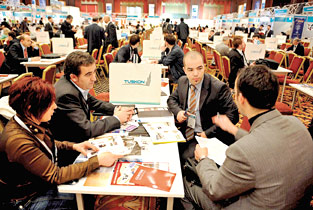
Beqir Cerkezi, an importer of motor oils from Pristina, Kosovo, appeared to be firmly in the smaller side of the SME camp and spoke with Today's Zaman in the early afternoon of the first day of the summit. Sitting at one of the dozens of small four-person tables in the convention hall where the meetings took place, he said, " I'm very surprised at how well this is organized," adding that he was " very happy" with the forum and was confident that he would be able to close a deal with one or more of the four or five Turkish exporters he had already met.
This view was reiterated by Paul Ghita, a general contractor from Romania, who was " very happy with the event" and said: " I think it is a very good idea. ... We are meeting good materials suppliers and lots of businessmen who want to collaborate. We also now have a different perception of Turkey."
These and other businessmen like them were able to benefit from the superior organization of the event, which has been described by organizers as " the most efficient matchmaking organization in the world." With the exception of the international airfare to Turkey and accommodation, the participation fee of 150 euros including all additional expenses incurred while in Turkey including meals, meeting stations and domestic transportation expenses (including domestic airfares).
Dozens of local organizations pooled their resources to arrange cars to pick up attendees from airports, tours of factories around Istanbul and flights to regional cities, as well as hosting services, with the Greater Istanbul Municipality footing the bill for a gala dinner and other government bodies supporting various other events.
Not all Turkish businesses saw the meeting as an opportunity in the same sense, however. Gani Öztürk, a merchandiser from Doksan Denizli Weaving Industries, one of the country's leaders in the home textile sector, noted that this was the third TUSKON-sponsored trade bridge that his company had attended, and articulated the views of larger companies of the event when he said that he was unhopeful of conducting any sales deals at the event. " We have a 1.5 million piece per month capacity; most people that approach us come asking us for 100-200 pieces," he said, noting that they cannot supply in such small quantities. According Öztürk, the fair presented a forum where they could get to know customer preferences in other countries in the region, served as a marketing platform where they could make their brand name known to businessmen and a place to invite these businessmen to Denizli to tour their factories. The textile sector is one of the sectors expected to be hardest hit as a result of the financial crisis and the shrinking of European export markets. For sales, Öztürk noted, they would much rather travel to large industry-specific fairs.
This view was echoed by Musa Tangören, area sales manager at Viko, a leading electrical products manufacturer in Turkey, who described the forum as " wonderful" and told Today's Zaman that they don't attend the forum for sales opportunities, but rather for " brand investment."
Meral underlined the importance of the forum in helping SMEs during the present economic crisis as it provided a lifeline to many ailing companies that are witnessing both their export markets and their bank credit shrink. " We are targeting mid-sized buyers of developing markets -- often general tradesmen," noting that they often " come with money in their pocket," buying a few containers of whatever they find profitable. " Just two container shipments of a product per month," he noted, " can mean the difference between life and death for a small Turkish manufacturer during this time of economic crisis."
Using the example of trade with African countries, which witnessed a threefold increase in trade with Turkey in the three years following the first TUSKON trade bridge, Meral was hopeful that trade between Turkey and the 16 countries of Central and Eastern Europe could increase more than fourfold in the coming four years to reach $100 billion.


