

The minister also underlined that the panicky mood among investors is being replaced with a calmer stance thanks to measures applied by a number of countries. Moreover, the effects of the external-oriented crisis on the Turkish economy have started to ease, he claimed.
Another point the minister stressed was that the world's most serious problem now is the financing of exports. Regarding this issue, the minister spoke about the government's plan to spare $1 billion in extra resources for the use of Eximbank as a support for exporters. " We are working arduously now to ensure that this amount is utilized as loans for exporters' needs both before and after they deliver their goods to customers abroad," he said.
" We have a chance to grab a larger share of the world market if we can achieve better foreign trade financing means. We are now in a position to use our own intermediary goods. This may mark the start of a new exports period in which our foreign trade deficit will be lower and we will be selling more value-added items to the world markets," he added. When asked if the government has any specific plan for the automotive industry, which has a leading share in Turkey's exports, the minister said it was extremely important for such a business to continue increasing its exports. " We are looking into this issue. What we will do, largely, is take measures to increase domestic demand," he noted. The minister also spoke about Turkish-Japanese business relations. The commercial relations between the two countries are rising steadily, he underlined, adding that friendly political relations are positively contributing to the strengthening of relations in every field. But trade is still far from meeting the actual potential, the minister confessed. " I hold myself responsible for this undesirable situation," he said. Tüzmen went on a comprehensive visit to Japan in October 2006 to boost relations. He met with numerous Japanese businessmen there to discuss means to boost commerce.
The trade volume between Japan and Turkey increased 27 percent in the January-September period of this year over the same period of the previous year to hit $3.5 billion. It is estimated that this amount will reach $4.3 billion despite an overall slowdown in exports due to the global crisis.
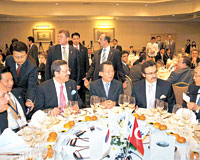
Tüzmen met with a South Korean business delegation later on in the day to discuss ways to improve trade relations between the two countries. He said the mutual trade volume had increased to $4.5 billion as of the end of 2007 from levels of $1 billion in 2002. " We have to set a target of $5 billion for the year ahead," the minister said, adding that $10 billion was definitely not an unrealistic goal. Speaking at the Turkish-Korean Business Council hosted by the Foreign Economic Relations Board (DEİK) in İstanbul, Tüzmen said Korean companies should see Turkey as a regional production and distribution center.
South Korean Prime Minister Han Seung-Soo was also among the participants in the meeting. Recalling that many Korean companies are active in Turkey, the visiting prime minister expressed his belief that relations between the two countries would develop faster. Han also noted that steps were being taken to initiate a free trade agreement between Turkey and South Korea.


