

Take for example Şırnak, a city in southeastern Anatolia, where rumors, unsolved murders and reports of missing people are widespread. The city residents are eagerly awaiting the widening of the investigation into Ergenekon. The people of Şırnak think that the expansion of the investigation is the only way to recover the remains of their loved ones. They strongly believe that the remains of the many who are missing are in deep wells and holes, like the three bodies that were discovered in a hole in an abandoned gas station a couple of years ago. The relatives of the missing think there are more holes and wells of death in the region.
In this mostly Kurdish area, many people disappeared during the harsh years between 1989 and 2001. Nobody knows how many are missing, but according to some estimates, it is at least a couple of hundred. Relatives who are brave enough to speak are adamant that their loved ones were the victims of Ergenekon. Some of the key suspects in the Ergenekon trial during those years worked in this region as military personnel, ironically with a mandate to fight against terror.
Not all murders went unnoticed. The victims who have now been recovered from unmarked graves by relatives and former neighbors were mostly ethnic Kurds living in Şırnak, Silopi and Cizre, centers of border trade and smuggling with Iraq.
Some left their houses one day, and some were detained in their houses. They went missing until recovery of remains. To name a few: Mehmet Fındık, the muhtar (a local official) of Doruklu village in Şırnak, his brother, Omer Fındık, and their cousin, Ömer Kartal.
"It was the last day of 1995. My brothers and our cousin were asked to bring some turkeys to the central military camp. According to eyewitnesses, they went there first, and later to the police station. They never came back," says Abdullah Fındık, now a lawyer but a student at the time.
He refers to observers who saw the three entering the police station one after another but he adds that they never came out. Next morning the car that they were using was found 300 meters away from the police station.
"It is the most difficult question in the world," says Fındık, when asked about what happened to his brothers and cousin, who were survived by eight children. "As a man of the law, I cannot say this without proof, but in my mind, I am 100 percent sure that Ergenekon did it," he states, adding: "Our hope is the Ergenekon investigation. If the prosecutors decide to look into wells and holes in this area, they will find many bodies," he says.
The investigation into Ergenekon started in June 2007, and, as prosecutors have deepened their investigation, more than 100 people, including former army commanders, have been arrested. Police following leads have recently discovered armaments, including hand grenades, in excavations in Ankara, but have not yet found any bodies.

Nüşiveran Elçi
Another lawyer, Nuşirevan Elçi, the chairman of the Şırnak bar association, thinks that if the police dig in the right places, they will be able uncover the remains of many victims. "Şırnak was given the status of province in order to provide Ergenekon a free hand," he claims, indicating the network used new powers to advance their agenda. Şırnak -- a city of 56,000 -- was given the status of province 19 years ago, and it became the base of operations of the some main suspects in the Ergenekon trial, people such as Col. Arif Doğan, Capt. Cemal Temizöz and Brig. Gen. Levent Ersöz. All have since retired but when they were active duty, they worked for gendarme intelligence. They were indicted as part of the Ergenekon investigation and are now on trial. Another common point between them is that fact that while they were in the area it was the time when people were going missing.
Haşim Haşimi, a former deputy who was once the mayor of Cizre, a district in Şırnak, points out that 1991 until 2002 were the most difficult years, full of clashes, extrajudicial killings and disappearances. "The municipality turned into an entity whose main job was burying people. The killing reached its peak when Ersöz was appointed as the local commander of the gendarmerie. There were some other state officials who were opposing what was going on but they were not powerful enough to resist it. It will be wrong to accuse the army totally, but some names in it, like Ersöz turned the area into hell," he says.
There were several attempts on Haşimi's life during that time. "Ergenekon, which has started to be discovered in Turkey now, was the reality of the East at that time," Haşimi says. Elçi reminds us that Tuncay Güney, a key figure in the Ergenekon investigation, also mentioned the acid wells full of bodies of those missing in state-owned Turkish Pipeline Corporation (BOTAŞ) facilities near the road between Cizre and Silopi. "It is widely known among the people that the wells and holes are full with bodies. In 2004, one was opened and three bodies were found. But there are many to look into. Ergenekon was so free to act here, not only the ones who were killed here but also others who disappeared in the surrounding areas were brought here. I guess only in this area there are around 200 bodies in the wells but the number in the wider region is even more," he underlines.
He adds that it was not only prominent people in the region who were considered obstacles to Ergenekon's activities in Şırnak, but also many normal men who were merely witnesses to crimes committed by the network.
Ever since the testimony of Güney was made public, the local bar association urged the public to speak about crimes they witnessed and to bring evidence forward. Yet according to Elçi, people are still afraid of coming forward.
"What Güney said is not new for the public here. But here is still an empire of fear. People are coming to us and telling what they witnessed, giving names and locations but they are still afraid of taking the case further. Until now, around 30 families have come to us but we have only been able to convince six of them. We will initiate prosecution procedures this week," Elçi says.

Abdullah Fındık
Fındık says his brothers had refused to be part of the "village guards," a paramilitary group established by the government in southeastern Anatolia to fight against terror and their number reached to 80,000 now.
It was not only the people who refused to be village guards -- people like Fındık -- that were the target of Ergenekon, but village guards themselves also fell victim to Ergenekon, individuals like Osman Demir. Demir was given several state awards for his active participation in antiterrorism operations, but became the victim of a plot set by Ersöz, according to a widely told story in this area and confirmed by his son Nimet Demir, who was a village guard himself.
"Ersöz planted some guns on our land and accused my father of helping the Kurdistan Worker's Party (PKK). It was an obvious setup. At the first hearing he was acquitted, but he had a stroke and died after it," Fındık said adding that at that time Ersöz targeted many prominent names.
Nimet Demir did not mention what might be the motive behind the alleged plot, but most in the region believed Ersöz had asked to transfer the right to use the state-owned land used by the Demir family to someone else. Nimet Demir was reluctant to talk about not only about his father but also about another event, which has happened to almost everyone in the region: the kidnapping of a relative. In Nimet Demir's case, the body of his relative was found by another member of his family in a well in which there were other bodies.

Rızgin Birlik
There a few persons in the region who are not under the influence of the "empire of fear," people like Rızgin Birlik, the chairman of the Şırnak branch of the ruling Justice and Development Party (AK Party), whose father and two uncles disappeared in 1996 in two different incidents. One of his uncles disappeared while returning to his house from a mosque. "He was a very peaceful person, a respected man and the muhtar of a village whose residents were forcibly evacuated by the government," Birlik says. Six months after his disappearance, Birlik's father and another uncle vanished.
"We were trading with Iraq, we had big trucks. First some unknown people blew the trucks up. When my father and uncle were driving to Iraq, they were stopped at the border by soldiers. The driver saw them when they were taken into a police station. They never came back from there," he says. He believes that they were killed by Ergenekon.
"Ergenekon's income is derived from here, they smuggled weapons and heroin here. If the Ergenekon investigation reaches here, the future of Turkey will be totally different, and it will be for the better," he says, adding, "Every day, when I hear the name of Ergenekon, pain wells up in the middle of my heart."
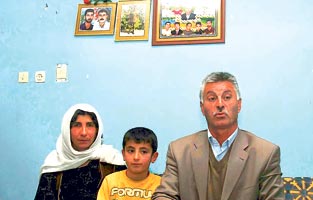
He is not alone in his feelings. As Elçi points out, some of the relatives of the disappeared are still waiting for their loved ones to return. One of them is Rabia Taniş, the mother of Serdar Taniş, a man who disappeared while in custody.

Suayip Taniş (R), the father of Serdar Tanış, says that his only wish is to find the remains of his son and to confront retired Brig. Gen. Levent Ersöz, who is being tried in Ergenekon case, in a courtroom.
"I want to know what happened to my son. If he is in a well, I want to see it," she says in Kurdish as she does not speak Turkish. But everybody, including the European Court of Human Rights which convicted Turkey in the case of Serdar Tanış, the local chairman of pro-Kurdish People's Democracy Party (HADEP) and his deputy Ebubekir Deniz, knows what happened to them. Both never returned from the central military post, which was run by Levent Ersöz, who told Suayip Taniş, the father of Serdar Tanış, that "If his son insisted on opening a branch of HADEP, he would no longer be living." Ersöz also told Suayip Tanış that Şırnak was his 'fief' and that he did not want HADEP there.
A reliable source pointed out that Ersöz was in Güçlükonak, a district of Şırnak, with his men when the prosecution issued an arrest warrant for him. He was taken from Güçlükonak by a helicopter after he started to be wanted. Since then it was thought that he had been in Russia as after retiring from the military he had become a representative for a Russian arms firm but he was captured in Ankara on Thursday. After Ersöz's capture it was reported that when he was fugitive an Azeri lady was with him all the time. When Ersöz was detained in Ankara, another former soldier, Selim Gül, was with him. Gül was one of the figures who testified at the European court in the Tanış case and was one of the last people to see Tanış alive.
Suayip Tanış says that his only wish to find the remains of his son and to confront Ersöz in a courtroom. Suayip, Fındık, Haşimi and Elçi are able to make a quick list of the wells and the names of the people whose remains waiting for to be discovered in there, all of them giving at least 50 names and several locations to search for them; Kasaplar Deresi, Kasrik Boğazı, Kırkkuyu, Kurtik village, Yah Çağlayan village, Rubehi village, Gezai village, Kuştepe village. The relatives of the victims also stress that when they search for loved ones, they get tips from local people in different places about bodies and remains, but because of fear most of this work has been done unofficially.
Elçi expects that when they will apply to the local prosecution of Silopi a district of Şırnak with their lists this week, their application most probably will be send to the regional special court in Diyarbakır and from there to Zekeriya Öz, the prosecutor in the Ergenekon investigation.
"Only if Öz starts an investigation into the wells can there be a result. Either the Ergenekon investigation will put Turkey on the path to a good future but if it is inconclusive, everything will be worse," Elçi underlines. AYŞE KARABAT ŞIRNAK / MARDIN


