

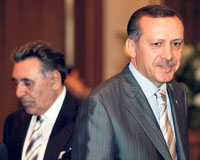

If two sides attach conflicting meanings to a problem, then that problem cannot be resolved easily. That is the case for the media and the government. They occupy such extreme opposites that it is impossible for them to empathize with each other. This media-government struggle has been going on ever since the foundation of the republic, gaining momentum at certain points. Based on the responses from political executives, both sides are trying to put pressure on each other. The government believes the media is pressuring the government to maintain the privileges they are accustomed to receiving and are even asking for democracy to be halted to that end. As for the media, they believe the government does not like to be criticized and therefore is attempting to win over newspaper editors and managers.
The struggle between the media and the government is an important difference between Turkey and other contemporary democracies. It is unusual to encounter a similar century-old struggle in countries undergoing a democratization process. The source of the conflict dates to the relocation of the capital from İstanbul to Ankara. At the beginning of the century, there was the İstanbul-based press known as "Babıali" (Sublime Porte). During that time Ankara was still a very small Anatolian village.
Ankara, which became the capital two weeks before the republic was founded, started printing its own newspaper. But the conflict between the İstanbul media and the Ankara media did not last very long. İstanbul's media was weakened after the collapse of the Ottoman Empire and the language reform that occurred five years after the foundation of the republic. Newspaper owners, editors and reporters tried to resist the reforms, but were tried in court and faced the death penalty.
During the single party period, both the media and opposition were suppressed. With financial and other support the government set up its own media groups. But these media groups later moved to İstanbul and transformed into today's media holdings. The media began functioning as the mouthpiece of the regime and have not been able to stop attacking social values. The statement by Aydın Doğan, "I am 100 percent laic, but they are anti-laic," to the Wall Street Journal and The Associated Press is a reflection of this stance.
But laicism alone is not enough to explain the current problem, which is rooted in history. This laicism-centered defense is not associated with concerns about the media. It is about holdings and their economic interests. There is pressure to take a stance against the government in order to protect these interests. In the way political parties are set up, media moguls can intervene in the decisions of who to elect as the leader and the prime minister. When they cannot impose their interests on a particular government, they cooperate with anti-democratic organizations to weaken that government. They have ideological obsessions.
These antiquated team efforts and corrupt relations re-emerged on the anniversary of the postmodern military coup of Feb. 28. Certainly Aydın Doğan's statement on this matter cannot be forgotten. He said, "My media organs have fought a war against coalition Islamist governments that were forced to step down as a result of military pressure in 1997."
Should a "100 percent laic" media owner boast about such an anti-democratic period? Doesn't this undermine the claim that laicism is the main issue within the larger problem? Shouldn't Doğan, who dislikes being associated as a media outlet for the Republican People's Party (CHP), adopt a neutral stance? That the military has confirmed that this media group, which has remained unusually quiet on the Ergenekon case, has collaborated with military personnel is extremely disturbing.
The only truth in articles against Turkey Those who assume that the Justice and Development Party (AK Party) will win the same percentage of votes in the local elections are writing articles that work against Turkey. Foreign press members who are influenced by the local media base their assessments on the claim that Turkey is headed down the path of radical Islam. Commenting on these claims, AK Party Deputy Chairman for Foreign Affairs Suat Kınıklıoğlu highlights the single correct aspect of such comments. That sentence is, "The events in Turkey today are the most important developments in the Middle East since the Iranian Revolution 30 years ago." Noting that articles against Turkey are far from being credible, Kınıklıoğlu said, "Contrary to claims, the March 29 elections will not only advance democracy but also serve as a referendum on Turkey's proactive foreign policies that have been in effect since 2007." Noting that Turkey's democratic experience, determination to join the EU and the proactive foreign policies applied to its neighbors are a historical process for the region, Kınıklıoğlu highlighted that these developments do not present any worrisome elements for Turkey's allies. |
.
Dollar's rise not a concern After several years the dollar has passed the 1.75 mark against the lira. While this has excited the media, it has not alarmed the government's economic officers. In fact the grins on their faces imply that they are quite happy. I asked them why they were happy. They said: "As the dollar increases, the current account deficit decreases. Profit increases as the global crisis puts pressure on exports. There is greater appeal for local manufacturing instead of importing intermediate goods so this means imports will drop as well. Imports will decrease at a faster rate than exports and this will affect the current account deficit positively. Turkey does not have an expenditure balance problem. While the global crisis is shaking the entire world, Turkey will become a safe haven as it closes its current account deficit. Turkey will be able to recover from the crisis quicker and will be able to turn the crisis into an advantage. "As for negotiations with the IMF [International Monetary Fund], Turkey will not accept traditional impositions. As Turkey's current account deficit is closing, the IMF will not be able to put as much pressure on Turkey. In other words, Turkey will advance from the minor leagues to the major leagues." |


