

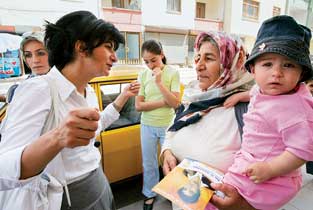
Women's representation in Parliament reached 10 percent following the July 7, 2007 elections, but their involvement in the country's local administrations remains low. There is only one female mayor in Turkey, Tunceli Mayor Songül Erol Abdil from the Democratic Society Party (DTP), while there are 3,225 mayoral offices in general. At the district level, the situation is no different; there are only nine female district administration heads and, in smaller units, there are only eight female leaders. When it comes to membership in provincial councils, the situation remains the same.
A recent report from the United Nations Development Programme (UNDP) regarding female representation in local administrations shows that in Turkey only 834 out of 34,477 local administrators are women.
Hülya Gülbahar, from the Association for Supporting Women Candidates in Politics (KADER), stresses that women are doing their best to change this situation, but that despite their efforts, the outlook remains bleak.
One of the campaigns that women have launched to increase their representation in local administrations is in Trabzon, under the slogan of "40 women for 40 mukhtar offices."
In the city of Trabzon there are 40 mukhtar offices, which are responsible for the administration of the neighborhoods, and six women's organizations, including the local branches of KADER, the Turkish Women's Union, the Turkish Mothers' Association, the All Women Association, the Black Sea Women's Solidarity Association and the Trabzon Women Artists Association.
According to the UNDP survey, not just women themselves, but voters in general (86 percent) are not happy about the low representation of women in local administrations, and one in every five voters is not pleased about the policies regarding women held by the political party they support.
In another survey conducted by the Gönülbirliği Cultural Solidarity Association in Ankara, three-quarters of the women surveyed were not interested in politics. Just 6 percent of them were members of political parties (primarily the country's biggest parties); and only 17.4 percent supported a particular party. The majority of them restrict their interest in politics to just reading or watching news about it.
When the women were asked what the most important thing in their lives was, politics came last. The vast majority of women, 72.1 percent, primarily want to be good mothers and wives.
Politics brings negative connotations to women's minds, according to the Ankara survey. For 28 percent of the women polled, the first thing politics calls to mind is lies, while for 27.3 percent the prime association is with unfulfilled promises and for 12.6 percent it is corruption. Almost all the participants in the survey said female representation in politics is very low and that measures should be taken to increase it by the state, political parties and nongovernmental organizations.
The UNDP, Gülbahar and two of the very rare female candidates for district mayor offices, Ayşe Fert Dökmeç from Eskişehir and Ayten Karadağ from İzmir, all seem to agree that female candidates are not encouraged enough and that local administrations are considered a "man's business" because of their executive nature.
According to the UNDP survey, this perception is the biggest reason women stay away from local politics.
"It is very difficult to get a place in male-dominated local politics," says Karadağ, a labor union representative and prospective candidate for İzmir's Buca district from the Republican People's Party (CHP).
Dökmeç, a lawyer and a prospective candidate for Eskişehir from the ruling Justice and Development Party (AK Party), also complains about the male chauvinist culture. "In order to be a candidate, you have to lobby in Ankara. But to even stay in a hotel in Ankara gets the attention of all the prospective male candidates, and most of them start to gossip about the family life of the female candidates."
Another main obstacle facing women in local elections, as well as in general elections, is the huge expense of campaigning. According to the Ankara survey, 66.4 percent of respondents said the biggest factor keeping women out from politics was the financial aspect.
"The cost of being a candidate for the mayoral office of a mid-sized district of a mid-sized city is around YTL 500,000," Gülbahar estimates.
A fee is required when applying to run as a prospective candidate for a political party. Most of Turkey's parties offer discounts for women. For example, the cost of being a prospective candidate from the AK Party for a metropolitan mayoral office is YTL 7,500, while for districts the cost is YTL 3,000. But female candidates are only required to pay two-thirds of these fees. But, of course, the expenses are not limited to application fees. Lots of posters and business cards are needed for advertising. Traveling throughout the target area, maintaining election offices and purchasing appropriate clothes constitute major expenses. But paying for dinners, lunches and even sometimes the hospital expenditures of voters is sometimes required. There are other expenses unique to Turkey, like presenting gold to newly married couples. All these costs are very discouraging for female candidates, as Dökmeç points out. "I was a candidate for the general elections, too. I distributed flowers, and it cost a lot. There are many visible and non-visible expenses of being a candidate. The local branch of the parties, or at least mine, help with these expenses, but still, in general, this could be very discouraging for women," she explains.
Karadağ also stresses the importance of solidarity, but says that struggling against male candidates financially is very difficult:
"Since female candidates don't have that much money to spare, even their chances of getting a spot in a local newspaper is low," she complains.
According to Gülbahar and the UNDP, party gender quotas are necessary for increasing female participation in local politics, but, in Turkey, only the DTP has a quota, 40 percent. The other parties have expressed a desire for women candidates but, for example, the AK Party is against quotas. AK Party leader and Prime Minister Recep Tayyip Erdoğan described quotas as "disrespectful of women, since it puts them under male control" at a meeting of the AK Party's women's branch ahead of the upcoming local elections.
For Gülbahar, the UNDP and the participants of the Ankara survey, gender quotas are not enough. Some other forms of encouragement are needed to increase the level of female participation, such as increasing female representation in political parties; cooperation between civil society organizations and female candidates; media efforts increase public awareness of the need for women's participation; and more financial support.
The participants of the Ankara survey add other recommendations, such as educating men, removing social obstacles facing women and increasing women's level of education. But many of them, 38.6 percent, stress that the most important thing for a female politician is the support of her family.
AYŞE KARABAT ANKARA


