

Washington says there should be no return to greater state control of financial markets. Much of Europe says without more regulation, a repeat of last year's turmoil is inevitable. British Prime Minister Gordon Brown called for more coordinated measures to spur economic growth, a policy area where there may be more consensus. " By acting now we can stimulate growth in all our economies. The cost of inaction will be far greater than the cost of any action," he told reporters in New York late on Thursday.
European Commission President José Manuel Barroso said he hoped to draw more emerging economies into global financial institutions such as the International Monetary Fund (IMF), saying Europeans were ready to lower their representation to make more room for countries such as China. " There is an openness to accommodate an increased role of the emerging economies," the International Herald Tribune quoted Barroso as saying.
Some in the West say they hope countries with large reserves, notably in the Gulf, will help fund the IMF, which has offered loans to economies laboring under heavy debts. Turkey has started to feel the impact of the global economic slowdown though its financial and banking industry is in good condition in contrast to US and European peers. To the dismay of the business community, the Turkish government has so far shied away from signing a standby agreement with the IMF, saying it does not need it. Standard & Poor's downgraded the country's rating from stable to negative on Thursday, citing downside risks having become more significant.
Pakistan, whose reserves are barely enough to cover nine weeks of imports, said it expected the IMF and other lenders to provide billions of dollars in loans soon and China to pitch in with $500 million to avoid a balance of payments crisis. But rating agency Standard & Poor's cut its sovereign ratings on Pakistan further into " junk" territory, highlighting the country's difficulty in raising the money it needs to avoid a default on its debt obligations.
Before the euro zone reported it was in a recession, Germany, Europe's largest economy, Spain and Italy all said their economies shrank in the third quarter. France escaped, reporting growth of 0.1 percent in the third quarter, but analysts said it was a semantic debate. " Whether we're in recession or not is only a technical debate," said Jean-Louis Mourier, economist at Aurel Leven. " Both the surveys and indicators we've seen leave no doubt that in spite of this slight rebound the economy is on quite a bad trajectory."
Spanish third quarter gross domestic product fell 0.2 percent, its first contraction in 15 years. Italy's economy shrank by 0.5 percent in the third quarter. The İstanbul Stocks Exchange (İMKB) increased 325.28 points on Friday. Stocks gained 1.3 percent in value and the index closed at 25,425.26 points at the end of the day. The dollar decreased to 1.60 against the lira from 1.64 on Thursday.
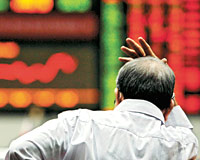
US stocks fell Friday after disappointing retail sales data while European and Asian stock markets were higher following Wall Street's strong finish from the day before. The Dow Jones index of leading US shares was down 141.45 points, or 2.5 percent, at 8,693.80, giving back some of Thursday's late 550 point advance. The Dow's opening retreat Friday, which was largely anticipated by futures markets following Thursday's third biggest daily points gain, pulled Europe's indexes off their earlier highs. The FTSE 100 index of leading British shares was 111.02 points, or 2.7 percent, higher at 4,280.23. Earlier it had been some 170 points higher.
Germany's DAX was up 163.66, or 3.5 percent, at 4,813.18. It too had been up some 190 points before Wall Street's open.
And the CAC-40 in France was up 66.23 points, or 2.0 percent, at 3,335.69, but lower than the 90-point advance it had posted earlier. The afternoon selling pressure in Europe came after further dismal US retail sales data reinforced concerns about the state of the world's largest economy. Earlier in Asia, Japan's benchmark Nikkei 225 stock average rose 223.75 points, or 2.7 percent, to 8,462.39, and Hong Kong's Hang Seng advanced 321.31, or 2.4 percent, to 13,542.66. Mainland China's key index rose 3.1 percent while markets in Australia and Singapore rose above 1 percent. South Korea's KOSPI ended flat after giving up an early rise.
Oil prices were steady around $58 a barrel Friday after rising overnight on speculation that the Organization of the Petroleum Exporting Countries (OPEC) will be cutting production again soon. Light, sweet crude for December delivery was up 29 cents at $58.53 a barrel, after rising as high as $59.96 earlier.


